
NEW PUBLICATION
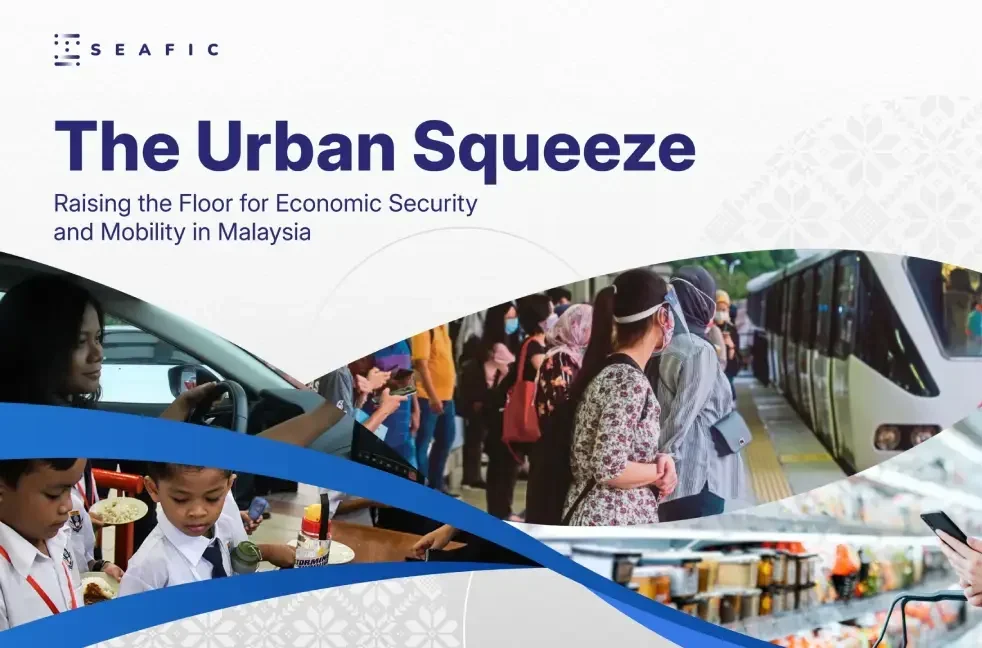
SEAFIC Research Report #2 – “Urban Squeeze: Raising the Floor for Economic Security and Mobility in Malaysia”
Summary: Rising wages and falling poverty have not insulated many households from financial strain, with unpredictable food, transport and utility costs leaving some families just a month away from crisis.
The study is based on a closed-door focus group of 15 residents from the B40 and M40 categories in Klang Valley, Malaysia, including fresh graduates, heads of households, single working mothers, gig workers and senior citizens.
Read here: https://seafic.org/seafic-research-report-2-the-urban-squeeze/
THE PAST WEEK

Chinese Data Centre Will Shape ASEAN’s AI Norms
Southeast Asian governments that lean on Chinese cloud providers for capital and capacity may end up importing the operating norms that come with them. Read more.
Summary: Alibaba Cloud opened two data centres in Johor in June, bringing its Malaysian footprint to five facilities, four months after ASEAN endorsed a Malaysia-led framework on cross-border cloud computing. Whoever builds and runs the region’s data centres shapes the technical and security practices of every service built on top of them. Chinese providers operating abroad remain bound by China’s Cybersecurity, Data Security and National Intelligence Laws, which the article compares to the US CLOUD Act and FISA 702. Once agencies and regulated industries build around one provider, switching standards means redesigning whole systems and retraining staff. The recommendation is for ASEAN governments to treat data centre investment as AI governance as well as industrial policy: diversify providers, clarify foreign data-access obligations, build domestic AI capacity and keep the right to audit. For Malaysia, which is both writing ASEAN’s cloud rules and hosting much of the capacity, the question is whether it will keep the practical ability to enforce those rules.

Between Interdependence and Diversification: Southeast Asia’s Room for Manoeuvre in Critical Minerals
Southeast Asia’s rare earth exporters are being told to pick between Chinese and US supply chains, but the choice is a false one. Read more.
Summary: A recent G20 finance meeting ended with only a chair’s declaration after China objected to language on critical mineral supply chains. China’s October 2025 rare earth controls, which reach foreign products containing as little as 0.1% Chinese-origin rare earths, are suspended until November 2026, while its April 2025 controls remain in force. Several East Asian economies have meanwhile joined the US-backed Pax Silica effort to build alternative supply chains. China’s dominance grew out of decades of industrial policy dating to the 1950s rather than a plan to build a geopolitical weapon, and both Beijing and Washington want Southeast Asian raw material mainly because it is cheap. The better test of any partner is what it contributes to processing, refining, skills and downstream manufacturing in the region. With the suspension of China’s broader controls due to lapse in November, this gives ASEAN mineral exporters, Malaysia among them, a basis for judging competing offers on what stays in the region.

ASEAN: From ‘Circumvention Export Hub’ to ‘Value Creation Hub’
A “Made in ASEAN 2.0” model would have the region create value itself instead of re-exporting Chinese inputs. Read more.
Summary: ASEAN’s reliance on Chinese components has fed American suspicion that the region is a channel for rerouted Chinese goods. Washington has meanwhile moved away from the WTO order that underpinned ASEAN’s growth and imposed unilateral tariffs. Since cutting off Chinese supply would damage the region’s industrial base, the proposal is to turn ASEAN into a “value creation hub” covering research, design, components, production and certification. Japanese firms, which built much of the region’s manufacturing clusters, would shift from “making in ASEAN” to “creating value in ASEAN” in EVs, semiconductors, AI and critical minerals. The piece also backs a common external tariff, first floated in the ASEAN Geoeconomics Report 2025, and linking CPTPP, RCEP, AFTA and the Japan-EU EPA through common rules of origin and customs procedures. This speaks to the trans-shipment suspicions that have shadowed ASEAN exporters in US trade talks, which Vietnam’s To Lam rebutted on 21 September.
Regional haze casts a pall on ASEAN’s influence
The return of smoke haze underscores a sobering reality: while ASEAN has policies designed to combat it, the problem continues to occur. Read more.
Summary: Smoke haze has returned to Southeast Asia, with fires in Indonesia's Sumatra and Kalimantan triggering the highest-level regional alert (Level 3) since August. Haze drifted as far as the southern Philippines this month, visibility at Pontianak's Supadio Airport fell to about 100 metres, Malaysia has asked Indonesia's permission to conduct cloud seeding over Indonesian territory, and Singapore has issued daily haze advisories.
This recurrence is a particularly revealing test of ASEAN's credibility because, unlike shared challenges such as Mekong water security (which involves non-member China), haze is a problem that ASEAN's own members largely cause and largely suffer, yet the bloc still struggles to resolve it through its own institutions, despite three decades of cooperation frameworks (the 1997 Regional Haze Action Plan and the 2002 ASEAN Agreement on Transboundary Haze Pollution).
Two structural constraints explain the gap: first, ASEAN's non-interference principle means it can monitor and coordinate but has limited authority to direct how a member state manages its own land, since fires stem mainly from domestic Indonesian land-use, licensing, and enforcement decisions; second, there's a persistent attribution/liability problem such as detecting hotspots is not the same as establishing legal responsibility for them, and the investigative and enforcement tools needed (concession maps, prosecutions) remain purely national functions ASEAN cannot build or command. Singapore's own Transboundary Haze Pollution Act is cited as an example of a national tool that demonstrates the seriousness of the problem but also its limits, since enforcement still depends on cooperation from the source country.
The piece closes by arguing climate change shouldn't be used as a scapegoat for what are largely governance failures, and that ASEAN's credibility now hinges on turning existing frameworks into practical results such as the common response protocols, compatible data-sharing systems, and pre-agreed cross-border resource-sharing arrangements.
Singapore’s finance firms pledge to train 80,000 local staff in AI skills
Twenty-three Singapore banks, insurers and asset managers have committed to train all their local staff in AI by 2028. Read more.
Summary: A first group of 23 financial institutions in Singapore has pledged to train more than 80,000 local employees in AI skills by 2028, Deputy Prime Minister and MAS chairman Gan Kim Yong announced on 24 September. More than half have already been through programmes recognised by an industry association. The firms will also study how roles change, starting with leaders, wealth managers and operations staff, and test ways to redesign jobs. Finance accounts for about 14% of Singapore’s economy and employs around 200,000 people, and the pledge extends last year’s commitment by Singapore’s three local banks to train all 35,000 of their local staff. The announcement came days after Prime Minister Lawrence Wong joined other leaders in a declaration calling for international oversight of frontier AI models. For ASEAN governments worried about AI displacing white-collar jobs, Singapore’s sector-wide, employer-led approach is a model to watch for results.

SEAFIC's Roundtable #4: Data Centres and The Compute Economy
The Southeast Asian Futures Initiative Centre (SEAFIC) on 24 September 2026 convened Roundtable #4, "Data Centres and the Compute Economy," bringing together government agencies, policy researchers and industry players for a closed-door discussion. Read more.
Summary: This Roundtable, held behind closed doors to examine what data centres deliver to host countries, how big the "compute economy" really is, and what is holding back results. Between 2021 and 2026, Malaysia approved 220 data centre projects worth RM385.7 billion, which have created 8,396 jobs. Early-career pay of RM3,000 to RM7,000 a month sits well above the national median of around RM2,900. But participants noted that Malaysian facilities employ about 2 people per MW, against about 7 in Singapore. Capacity has grown from roughly 100 MW to more than 1,000 MW in about four years, outpacing the grid, with transformers alone taking up to five years to deliver.
Government presenters outlined a 2025 task force, a rule that accepts only AI-focused, less water-intensive facilities, a proposed 30% local content requirement and the Data Centre Nexus platform for matching local suppliers. Participants argued the returns are long-term, and warned that restrictions are easier to impose than to reverse. Thailand recently imposed a moratorium affecting 49 sites, while Singapore has reversed its own to stay competitive. The roundtable called for a consistent way to measure benefits, including indirect spillovers, clearer local content rules, assessments of effects on SMEs, heat and water use, and more involvement of state and local governments. For Malaysian policymakers, the message is that capital is easy to attract, so the harder task is turning land, power and water commitments into local jobs and supplier capacity.
STRATEGIC INSIGHTS
A very strong El Niño could lift palm oil, sugar and rice prices through 2027
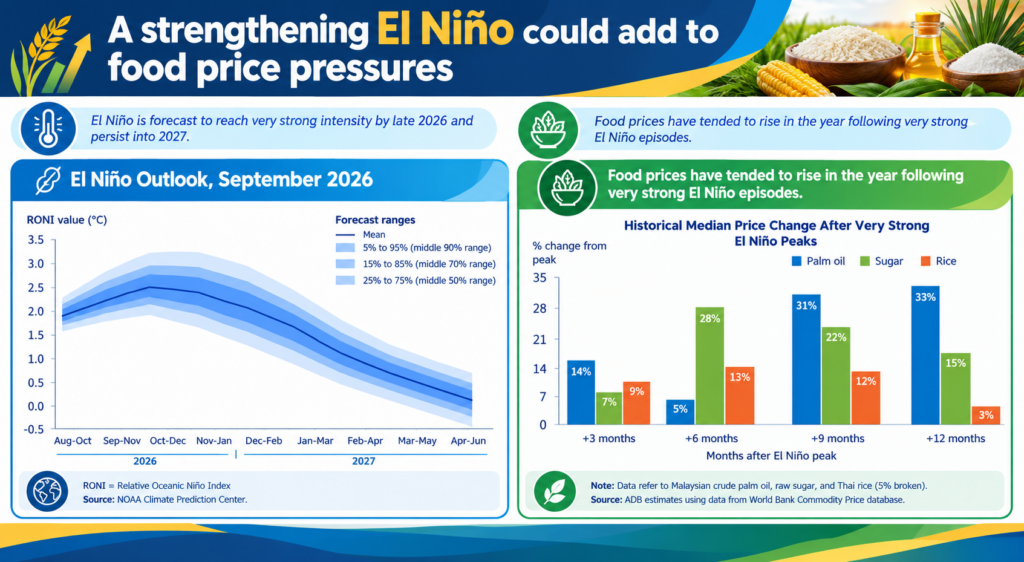
The Asian Development Bank’s Asian Development Outlook September 2026 expects El Niño to reach very strong intensity by late 2026 and persist into 2027. Citing the US National Oceanic and Atmospheric Administration (NOAA), the report puts the probability of a very strong El Niño between September 2026 and February 2027 at over 90%, with a 75% chance that the October–December event exceeds any since 1950.
The chart shows NOAA’s forecast of the Relative Oceanic Niño Index, with the mean peaking at about 2.7°C in October–December 2026 and easing through the first half of 2027. The right-hand chart shows ADB’s estimate of how prices of Malaysian crude palm oil, raw sugar and Thai 5%-broken rice have moved after past very strong El Niño peaks. Read from the chart, the median palm oil price is roughly a third higher 12 months after the peak, sugar is up by about 28% at six months, and rice rises by around 12% at six and nine months.
All three commodities are central to Southeast Asia, as producers and as consumers. ADB’s Malaysia chapter cites the Malaysian Meteorological Department’s projection that El Niño effects will peak between March and May 2027, with Sabah, Sarawak and the northern peninsula most affected, and estimates palm oil and rice yield losses of around 10% to 18%. ADB has raised its 2026 inflation forecast for developing Southeast Asia by 0.1 percentage points to 4.0%, and expects El Niño to keep prices elevated in Malaysia and Indonesia.
For food security planners the timing matters. If the historical pattern holds, the largest price effects will arrive in mid- to late 2027, well after the weather peak, which leaves a window for rice stock-building, irrigation work and coordination through the ASEAN Plus Three Emergency Rice Reserve.
THE WEEK AHEAD: STRATEGIC WATCHLIST
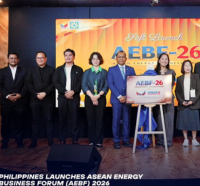
44th ASEAN Ministers on Energy Meeting and the 26th ASEAN Energy Business Forum (05 - 09 October 2026)
Why it matters: Energy ministers from all 11 ASEAN member states meet at the Philippine International Convention Center in Manila under the Philippines’ chairship, with the business forum running alongside under the theme “Clean Energy Unlocked: A Stronger ASEAN”. The Philippine Department of Energy says the programme covers the ASEAN Power Grid, renewable energy certificates, energy efficiency and financing, and will see the launch of the 9th ASEAN Energy Outlook.
The ASEAN Centre for Energy estimates the region needs about USD$200 billion a year in energy investment by 2030, three-quarters of it for clean energy. Outcomes feed into the 49th ASEAN Summit in November.
2026 Annual Meetings of the International Monetary Fund (IMF) and the World Bank Group (WBG) (12 - 18 October 2026)
Why it matters: This is one of the two biggest set-pieces in global economic governance each year, bringing together finance ministers, central bank governors, and top officials from all 191 IMF member countries alongside the World Bank Group. The forum is where decisions on global financial stability, sovereign debt, and development financing actually get made, not just discussed. Its location makes it especially significant for ASEAN specifically: Thailand last hosted these meetings in 1991, so this marks a 35-year gap, and the choice of Bangkok is being framed by the IMF itself as recognition of Asia's growing centrality to global economic and financial stability decision-making.
For anyone in finance, trade, or economic policy across the region, this is an unmissable convening where the world's most senior economic policymakers will be physically present in Southeast Asia for a full week, creating a rare concentration of bilateral meeting opportunities, high-level panels, and signal-setting on everything from debt sustainability to AI's economic impact (a topic the IMF has been increasingly vocal on) happening right in ASEAN's backyard.
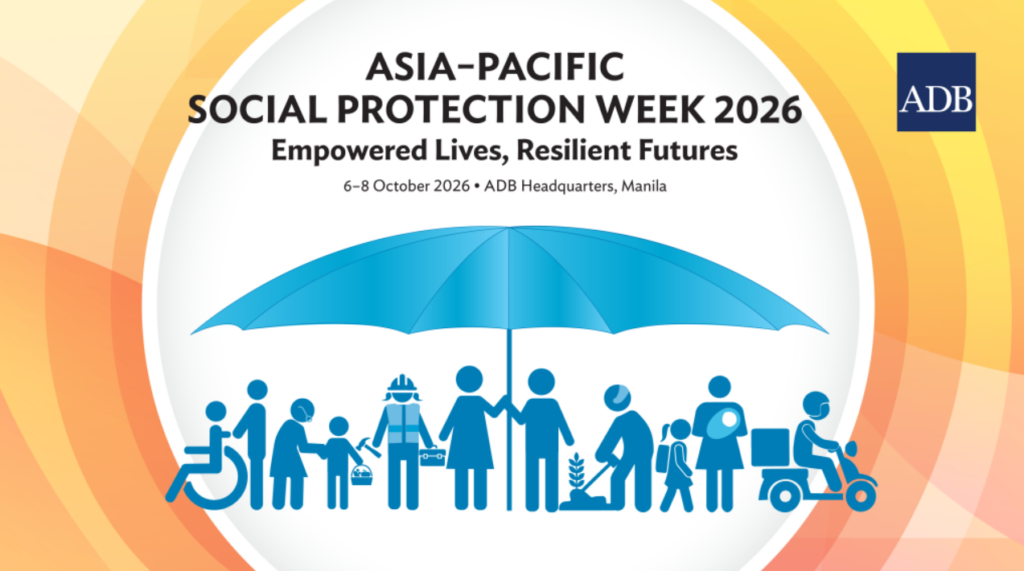
Asia-Pacific Social Protection Week 2026, ADB Headquarters (06 - 08 October 2026)
Why it matters: The Asian Development Bank brings government leaders, policymakers and development partners together to take stock of social protection systems across Asia and the Pacific and set priorities for the coming years. It is the first edition since 2023 and will be held in Manila, the Philippines.
The timing matters for ASEAN labour markets: ADB’s September outlook expects a very strong El Niño and high energy prices to push up food costs into 2027, which will test cash transfers and other safety nets, while governments are also weighing how to protect workers displaced by AI.
