
THE PAST WEEK
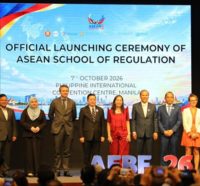
ASEAN Launches School of Regulation To Strengthen Regional Energy Cooperation.
A new ASEAN initiative aims to improve regulatory coordination and unlock investment in cross-border energy infrastructure. Read more.
Summary: The ASEAN School of Regulation (ASR), jointly led by the ASEAN Energy Regulators Network, the ASEAN Centre for Energy and the ASEAN Secretariat, was officially launched on 7 October 2026 at the 44th ASEAN Ministers on Energy Meeting in Manila, Philippines. The initiative was developed in partnership with the United Nations Office for Project Services and the United Nations Economic and Social Commission for Asia and the Pacific.
Initially focusing on power system integration and multilateral electricity trade, the ASR will support the implementation of the ASEAN Power Grid and the ASEAN Plan of Action for Energy Cooperation 2026–2030. Its programmes will strengthen regulators' expertise in power systems, market design, economic regulation and cross-border electricity trading, while promoting greater regulatory consistency across ASEAN member states.
Malaysia will host the institution, with UNITEN Research and Development serving as its permanent secretariat and operational platform. By improving regulatory capacity and alignment across the region, the initiative aims to facilitate cross-border electricity trade and create a more predictable environment for investment in electricity grids and related energy infrastructure.
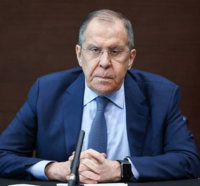
ASEAN Secretary-General visits the Russian Federation Minister of Foreign Affairs in Moscow.
Dr. Kao Kim Hourn and H.E. Sergey Lavrov exchanged views on the Advance 2026-2030 Partnership Plan. Read More.
Summary: On 13 October 2026, Kao Kim Hourn met with Sergey Lavrov in Moscow during his working visit to Russia. The two sides reviewed ASEAN-Russia cooperation and discussed concrete ways to advance the partnership under the ASEAN-Russia Comprehensive Plan of Action (2026-2030), adopted at the Commemorative Summit in Kazan in June.
Both parties reaffirmed the importance of promoting peace, stability and prosperity in the region, and exchanged views on regional and international developments. According to Russian news agency TASS, topics such as energy and food security were also on the agenda, with prospects for strategic partnership and efforts to address emerging challenges in the Asia-Pacific region.
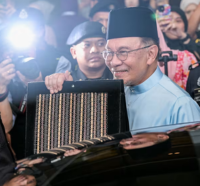
SEAFIC Welcomes Malaysia’s Budget 2027.
Belanjawan MADANI 2027 speaks to the urban squeeze while also laying the groundwork for an AI-driven economy. Read more.
Summary: SEAFIC highlights Malaysia’s RM510 billion Budget 2027 in its effort to ease household cost pressures while preparing the economy for future growth. The Budget targets a fiscal deficit of 3.3% of GDP in 2027 and introduces measures to support workers, first-time homebuyers and lower-and middle-income households.
From June 2027, the minimum wage will rise from RM1,700 to RM2,000, while a proposed RM2,500 starting salary for graduates and semi-skilled workers aims to strengthen income security. Housing loan guarantees, expanded cash assistance and subsidies for public transport and affordable food are also intended to ease the urban cost of living. Support for gig workers includes improved social protection and access to financing.
To build an AI-driven economy, the Budget supports data-centre investment, a Sovereign AI Cloud and efforts to develop 200,000 AI-skilled workers, alongside helping 4,000 small and medium-sized enterprises adopt AI. SEAFIC also highlighted regional investment and energy cooperation, stressing that effective implementation will be crucial to ensuring economic growth translates into tangible benefits for households.
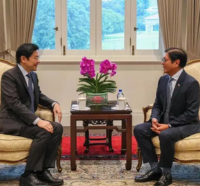
Marcos visits Singapore Seeking Greater Investments and Strategic Energy Partnerships.
The Philippines looks to deepen investment ties with Singapore and explore nuclear energy cooperation as both countries prepare for evolving regional priorities. Read more.
Summary: Philippines President Ferdinand Marcos Jr met Singapore Prime Minister Lawrence Wong during a working visit to Singapore from 7 to 11 October 2026. The visit aimed to strengthen their bilateral ties, expand economic engagement, and advance cooperation in sectors that could support Philippine’s development.
During the visit, President Marcos was scheduled to attend the Forbes Global CEO Conference to promote investment opportunities in the Philippines and engage with other international business and investors. Singapore is a key source of foreign investment for the Philippines, with bilateral cooperation extending into areas such as digital infrastructure, renewable energy and climate finance.
Nuclear energy cooperation was also on the agenda, with Marcos visiting the Singapore Nuclear Research and Safety institute to learn from Singapore's experience with nuclear research, safety, regulation and capability building as the Philippines explores nuclear energy as a potential part of its long-term energy mix amid rising electricity demand. The visit also provided an opportunity to discuss regional developments ahead of Singapore’s 2027 ASEAN chairmanship.
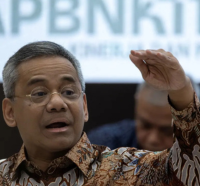
Indonesia Orders Spending Cuts to Keep Fiscal Deficit Below 3%.
Indonesia tightens government spending as rising energy costs and fiscal pressures complicate efforts to meet its deficit ceiling. Read more.
Summary: Indonesia’s Finance Minister, Suahasil Nazara, has ordered ministries and government agencies to cut their remaining travel budgets by 30% and freeze non-essential spending for the rest of 2026. The measures aim to keep the country’s fiscal deficit within its legally mandated ceiling of 3% of GDP, amid growing investor concerns over the government's fiscal sustainability under Prabowo’s administration.
Government agencies must prioritise online meetings and suspend new vehicle procurement, as well as the construction and renovation of official residences and buildings. Additionally, all government agencies are required to submit their proposed budget cuts to the Finance Ministry by 16 October 2026, while ensuring that essential public services remain unaffected.
Indonesia’s fiscal position has also been complicated from rising global energy prices, which are increasing the cost of energy subsidies. The government’s latest deficit estimate for 2026 stands at 2.85% of GDP, above its initial target of 2.68%.
Last year, President Prabowo had already slashed spending plans by USD 19 billion, to keep the annual deficit below the ceiling, which forced regional governments to hike local taxes resulting in triggering protests in many provinces.
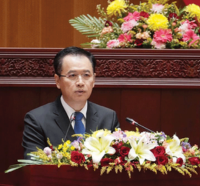
Laos Government Bans All Raw Mineral Exports by 2030.
Laos aims to expend domestic mineral processing to capture greater value from its natural resources and strengthen its industrial base. Read more.
Summary: Laos plans to phase out raw mineral exports by 2030, according to Industry and Commerce Minister Malaithong Kommasmith. He noted that the country’s resilience on exporting unprocessed minerals has limited the economic benefits generated from its mineral wealth.
The government is drafting a Prime Minister’s directive requiring new mining projects to establish processing facilities, while existing projects face renewed regulatory scrutiny as Laos moves to restrict raw mineral exports. New rare earth approvals have been frozen, and raw exports of minerals such as cobalt, tungsten, and nickel will be phased out by 2030. Gold, copper and bauxite and potash miners must integrate with domestic processing plants.
The policy is already attractive investments: the Asia Potash Industrial Park has drawn 14 factories worth over USD 730 million, with 9 factories already operating and nearly 2000 people already hired. High transport costs, fragmented supply chains and limited electricity infrastructure could hinder progress, so stricter investor screening and production monitoring are proposed to reduce revenue losses.
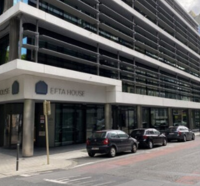
Vietnam Set to Sign Free Trade Pact with European Bloc.
Vietnam’s planned free trade agreement with the European Free Trade Association (EFTA) aims to expand market access, strengthen investment ties and diversify its trade partnerships amid global uncertainty. Read more.
Summary: A Free Trade agreement between Vietnam and the EFTA is set to be signed on 18th October 2026, following negotiations that began in 2012 and concluded in July. EFTA comprises Switzerland, Norway, Iceland and Liechtenstein.
The EFTA stated that the agreement will cover trade in goods and services, investment, intellectual property rights, government procurement, and sustainable development. It will also include efforts in reducing trade barriers as well as cooperation and capacity building between the two sides. Bilateral trade between EFTA and Vietnam reached USD 5.4 billion in 2025, up from approximately USD 561 million a decade earlier.
The deal comes amid heightened global trade tensions, including uncertainty over US tariffs.
STRATEGIC INSIGHTS
Food Price Risk is Rising in Southeast Asia while Public Concern Falls.
Southeast Asian households have grown less worried about food at the point where the price data turned. The 2026 Southeast Asia Climate Outlook Survey, run by the ISEAS - Yusof Ishak Institute, found 25.4% of respondents very concerned about food availability and affordability over the next three years, down from 30.2% in 2024, with the somewhat concerned share falling from 46.0% to 33.0%. Laos was the only country where concern rose.
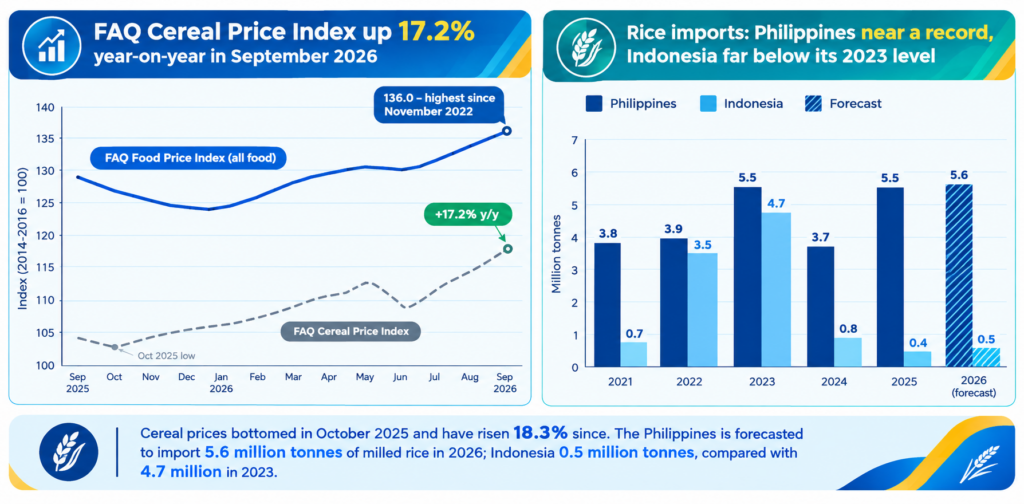
The published prices moved the other way. The FAO Food Price Index averaged 136.0 points in September 2026, 1.5% higher m/m and 5.8% higher y/y, its highest reading since November 2022. The cereal sub-index rose 5.1% m/m to 122.8 points, 17.2% above September 2025 in both nominal and real terms, having bottomed at 103.8 points in October 2025. Thai 100% B white rice was quoted at USD466 a tonne on 30 September 2026, 31.3% above a year earlier. FAO expects international rice trade to fall 2.2% in 2026E before recovering 1.7% in 2027F, and puts world cereal stocks-to-use for 2026/27 at 31.7%, down from 32.0%.
Exposure is unevenly spread. The United States Department of Agriculture forecasts Philippine milled rice imports of 5.6 million tonnes in 2026F, close to a record, while Indonesia's fall to 0.5 million tonnes from 4.7 million tonnes in 2023. Manila suspended imports of 5% broken rice on 9 September 2026 to support farmgate prices, which has already slowed sales from Viet Nam, so a tightening world market now meets a buyer holding itself out of it.
The timing is the hard part. The Agricultural Market Information System puts the probability of a very strong El Nino from September 2026 to January 2027 above 90%, ranking it among the strongest since 1950, and notes that rice yields in such years typically run 1.0% to 1.5% below trend. FAO Chief Economist Maximo Torero said on 2 October 2026 that if sustained, these pressures "will soon pass through to consumer food prices, especially in food and energy import dependent countries".
Budget cycles closing across the region this quarter are therefore the practical decision point for irrigation, early-warning and stockpile spending, and for reserve release rules that can be triggered before retail prices move rather than after.
Prices turned up in late 2025, and import exposure is diverging
THE WEEK AHEAD: STRATEGIC WATCHLIST
Indonesia Trade Expo (TEI) 2026 (14 - 18 October 2026)
Why it matters: The expo will be held at the Indonesia Convention Exhibition (ICE) BSD City, Tangerang Regency, Banten, under the theme “The Ultimate Hub for Global Sourcing”. Organized by the Ministry of Trade, it will serve as a strategic platform to connect Indonesian exporters, including MSMEs, with the global market. The expo targets USD 17.5 billion in potential transactions and aims to open up investment and business collaboration opportunities through product showcases, business matching and export-development activities. The event also proposes an opportunity to strengthen economic ties with partner countries, with ministerial visits to be facilitated.

Philippine International Nuclear Supply Chain Forum 2026 (20 - 21 October 2026)
Why it matters: The Philippine Department of Energy (DOE) announced a major partnership with the World Nuclear Association to merge into a unified nuclear energy forum in Manila, Philippines. It aims to bring global nuclear leaders, financiers and technology developers to the region. It expects to help the Philippines build the regular, technical and industrial groundwork needed to begin a domestic nuclear power program, focusing on progressing individual projects to national programs. As ASEAN countries represent about 24% of capacity targets among newcomers to nuclear energy, the event will cover industrial readiness, vendor development, financing and localization.
Source: Philippine Information Agency

Malaysia Cloud & Datacenter Convention 2026 (22 October 2026)
Why it matters: The convention will be held in Kuala Lumpur, Malaysia. It is expected to gather over 1,500 senior IT, data centre and cloud leaders. Malaysia is one of Southeast Asia’s fastest-growing data center markets, while AI workloads, data sovereignty and sustainability expectations are reshaping how facilities are built. Discussions are set to cover AI infrastructure, hyperscale and sovereign cloud, and the supporting systems of power, cooling and connectivity. Its significance lies in convening senior industry leaders, investors and government stakeholders around the physical and technical foundations of AI and cloud growth in Malaysia.
