
THE PAST WEEK
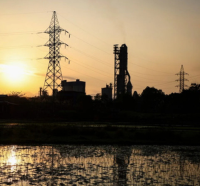
Inside America’s $1.5 Billion investment bet on Southeast Asia’s energy
Washington’s decision to invest in Southeast Asia’s future energy security serves both as a commercial interest and to address regional energy security Read more.
Summary: The United States announced $1.5 billion in financing through its International Development Finance Corporation in July 2026 with an additional $2.5 billion commitment for energy security and future technologies across ASEAN.
The investment targets liquefied natural gas (LNG) infrastructure, grid modernisation technology, and nuclear expertise. Apart from addressing regional energy security, analysts also note that the push serves as Washington’s geoeconomic interest to expand markets for US LNG exports while countering China’s dominance in the region.
US Ambassador Kevin Kim framed the initiative as supporting ASEAN's collective digital economy development and energy security. The announcement came during Secretary of State Marco Rubio's visit to Manila for ASEAN foreign ministers' meetings, underscoring energy's centrality to Indo-Pacific strategic competition.
However, analysts caution that the real test lies not in announced capital but in actual delivery. Large-scale energy infrastructure projects carry inherent implementation risks and ASEAN has seen varied outcomes from comparable multilateral commitments. Success will depend on whether the US translates these pledges into sustained project execution across the region.

Malaysia Emerges as Asia's Standout Growth Story on AI and Semiconductor Surge
Malaysia's pivot to artificial intelligence and semiconductor manufacturing is reshaping its economic trajectory amid rising geopolitical tensions and Middle East conflicts. Read more.
Summary: Malaysia is experiencing unprecedented investment flows into artificial intelligence and semiconductor manufacturing, marking a dramatic economic turnaround.
Malaysia's economic performance reflects this investment surge. Data centre investments have climbed to an estimated 18% of GDP —the highest share globally— while the country has become one of four major net exporters of AI-related hardware globally, alongside South Korea, Taiwan and Thailand. The shift towards Malaysia has been accelerated by geopolitical disruptions, particularly in the Middle East. Projects initially planned for the region have been redirected to Malaysia, drawn by its established industrial base, relatively stable political environment, and perception as a neutral country.
However, political risks threaten continuity. Prime Minister Anwar Ibrahim's coalition suffered significant losses in recent state elections, raising questions about prospects for winning another term in national elections due by early 2027.
Analysts remain cautiously optimistic that policy consistency will hold despite political uncertainty. However, the sustainability of Malaysia's growth depends on navigating fiscal constraints, managing uneven sectoral growth between tech and consumer-facing industries, and maintaining political stability through the electoral cycle.
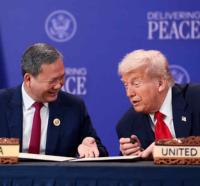
ASEAN continues Partial Implementation of US’s Reciprocal Trade Agreements (ARTs) despite Supreme Court rule as invalid early this year
ASEAN countries are maintaining selective implementation of reciprocal trade agreements reached with the US last year, even after the US Supreme Court invalidated their legal basis in February 2026. Rather than exit the deals, ASEAN nations remain bound by US pressure and by their own trade dependency on American markets. Read more.
Summary: In 2025, the Trump administration imposed reciprocal trade agreements on ASEAN nations requiring labor protections, data localization, and vehicle safety standards. Though the US Supreme Court invalidated these tariffs' legal basis in February 2026, ASEAN countries continued implementing them.
Three binding constraints trap ASEAN in compliance despite the legal void. First, Washington explicitly threatened Section 301 tariffs against non-compliant nations, using forced-labor allegations as enforcement. Second, ASEAN's trade dependency is acute. Cambodia and Vietnam achieved record US exports in early 2026, making withdrawal economically untenable. Third, geopolitical vulnerability constrains options. Rejecting US demands risks bilateral relationships essential for strategic balance between great powers.
Yet compliance remains inconsistent. Cambodia complied (labor legislation, vehicle imports). Indonesia and Malaysia resisted data restrictions. By July 2026, Trump announced tariffs ranging from 10 to 12.5%, with slightly lower rates offered to countries that demonstrated compliance. This move tightened the pressure on ASEAN nations and made withdrawal from the agreements unviable.

Thailand Tightens Controls on USDT Transactions to Combat China-linked Crime Networks
Thailand's July 2026 announcement of USDT audits targets transnational criminal networks linked to Chinese nationals laundering proceeds across Southeast Asia. Read more.
Summary: Thailand's Bank of Thailand announced audits of high-volume USDT (Tether) transactions in July 2026, discovering that nearly 40 percent of stablecoin sellers on local platforms are foreign nationals. This reflects Thailand's infrastructure-level enforcement targeting transnational criminal networks linked to Chinese nationals that exploit digital assets to launder proceeds from scams, gambling, and other crimes across Southeast Asia.
USDT has become the preferred vehicle for these networks due to its price stability, liquidity, and rapid settlement capabilities. Recent arrests illustrate the scope: Thailand arrested suspects tied to Chinese scam syndicates laundering cash into digital assets, pursued warrants for Chinese businessman Wang Yicheng for global scam money laundering, and apprehended a Chinese national linked to FINTOCH, a fraudulent crypto investment scheme.
Thailand's approach evolved from individual prosecutions to systematic enforcement targeting payment infrastructure. Early 2026 actions included filing criminal complaints against unlicensed offshore digital asset operators and blocking unauthorized platforms. The emphasis on cross-border capital flows reflects the prevalence of scam compounds in Myanmar, Cambodia, and Laos that rely on digital assets to move proceeds across borders.
STRATEGIC INSIGHTS
Compared to peer countries, Malaysia’s fossil fuel dependence remains high
The chart provides a peer comparison between Malaysia and several ASEAN countries on their energy mix in three distinct years; 2000, 2010, and 2023. Two points can be inferred from the chart on Malaysia’s energy mix:
- It remains dependent on fossil fuels, with oil, coal, and natural gas supplying roughly 96% to 98.1% of Malaysia’s total energy supply in the listed years (2000, 2010, 2023), while renewables, waste and others occupy a meagre 3% to 4% throughout.
- Coal gradually displaces oil in the fossil fuel energy share. Coal rises from about 5% (2000) to some 20% (2010) and roughly 22% (2023); oil falls from about 39% to some 31%; gas holds between 40 and 43% across all three years. Coal has been an important energy source since the 2010s as a cheaper alternative to gas. However, this also signifies an increase in emissions intensity of the energy mix, as gas carries lower lifecycle emissions than coal.
What does this mean for our NETR targets?
Malaysia has committed to phasing out coal power by 2044, retaining gas as a transitional fuel, and raising renewable installed capacity from the 31% reached in 2025 to 40% by 2040 and 70% by 2050. Set against a fossil share that has held at 96 to 97% since 2000 and has grown more coal-weighted over that period, those commitments require a break from twenty-three years of trend.
This comes at a time where data centres are projected to consume one-third Malaysia’s electricity by 2035, which accentuates the importance of accelerating renewable transition agendas to hedge against geopolitical headwinds and the natural depletion of domestic gas supplies in the same decade.
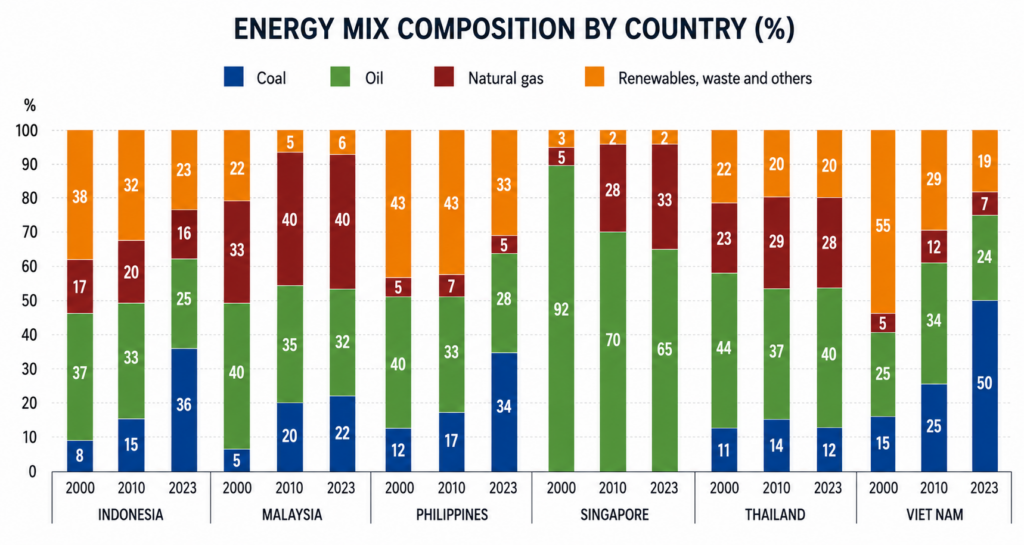
Fossil fuel dependence is high compared to peer countries (Page 58)
Source: Organisation for Economic Co-operation and Development (OECD)
THE WEEK AHEAD: STRATEGIC WATCHLIST
59th ASEAN Day Celebration (08 August 2026)
Why it matters: On its own, an anniversary date is largely ceremonial — flag-hoistings, ambassador remarks, commemorative statements. But this year's framing gives it more weight than usual: it lands at the start of ASEAN's first year implementing the "ASEAN 2045: Our Shared Future" vision (adopted May 2025), under the Philippines' chairmanship theme "Navigating Our Future, Together."
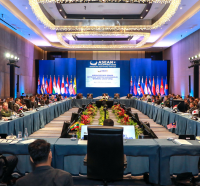
ASEAN Defence Senior Officials' Meeting (ADSOM) and ADSOM-Plus (with Australia, China, India, Japan, South Korea, New Zealand, Russia, US as "Plus" partners) (10 - 14 August 2026)
Why it matters: This is the working-level preparatory meeting for the ASEAN Defence Ministers' Meeting-Plus (ADMM-Plus) later in 2026 — the region's top defence dialogue platform. It's where language on flashpoints (South China Sea, Myanmar, the Thailand-Cambodia border) gets negotiated before ministers meet, and it's one of the few forums that brings China, the US, and Russia to the same table with ASEAN on security matters.
Source:https://photos.asean2026.gov.ph/uploads/b3403800-0269-46df-81c685b5b388ec0d.pdf
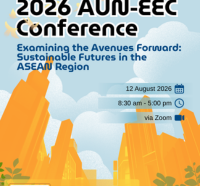
2026 AUN-EEC Conference: "Examining the Avenues Forward:Sustainable Futures in the ASEAN Region" (12 August 2026)
Why it matters: ASEAN University Network on Ecological Education and Culture (AUN-EEC). This is a genuine ASEAN-wide conference which focuses on future thinking applied to sustainable development, education, community resilience, water, and climate action across ASEAN.
