
THE PAST WEEK
According to Thailand's National Economic and Social Development Council (NESDC), Thailand’s economy expanded 2.8% in the first quarter of 2026, rising from 2.5% growth in the previous quarter and beating a 2.2% forecast by Reuters. Read more.
Summary: Thailand’s economy bucked a regional slowdown among the country’s Southeast Asian peers, with growth fueled by increased investment, goods exports, and higher government expenditure. Goods exports rose 15.5% year-on-year, driven by exports of high-tech electronic products. However, the ongoing war in Iran has still had an impact on Thailand, including its vital tourism sector. Foreign visitor arrivals already contracted 2.4% in the first quarter to 9.3 million.
Government pushing ahead with THB 400 billion emergency borrowing plan
Thailand’s government is pushing ahead with a THB 400 billion emergency borrowing plan, which will fund cash handouts, fuel relief, and subsidies, as well as accelerate Thailand’s transition from fossil fuels to renewable energy. The package is in response to the fallout from the Iran war, which has driven up energy prices and disrupted trade and tourism. Read more.
Summary: As the first step under the emergency plan, the cabinet on 19 May approved a THB 175 billion baht relief package that includes cash handouts for about 13 million welfare cardholders and a four-month consumption program covering roughly 30 million people. This is despite Thailand’s charter court on 18 May agreeing to review whether the emergency decree, which allows the Finance Ministry to raise funds without parliamentary approval, meets constitutional requirements for urgent necessity.
Malaysia’s inflation in April accelerates to fastest pace in one and a half years
The consumer price index rose 1.9% month-on-month in April 2026, the highest reading since October 2024, and a rise from the 1.7% gains made in March. Read more.
Summary: The ongoing war in Iran has seen oil prices remain elevated, leading to a rise in the prices of petroleum-derived goods from petrol to fertilisers amid the supply disruption. Prices of diesel alone are now nearly double the level before the outbreak of the Iran war on 28 February. The transport index, which measures price changes including that of petrol and public transport services, rose to 4.1% year-on-year in April compared to 1.6% increase in March. The inflation of food and beverages, which accounts for nearly 30% of the index’s weightage, was slightly higher at 1.2% in April versus 1.1% in March.
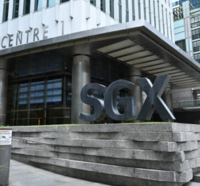
Singapore overtakes Indonesia as Southeast Asia’s largest stock market
Singapore has overtaken Indonesia as Southeast Asia’s largest stock market, with the former’s market capitalization climbing to more than USD 645 billion, while that of Indonesia dropped by more than 30% to USD 618 billion. Read more.
Summary: Singapore benefits from its economic and political stability, as well as government-led initiatives aimed at reviving a previously lackluster equity market. In contrast, investors are concerned about Indonesia’s potential reclassification to frontier market status by MSCI, as well as recent credit rating outlook downgrades by Fitch Ratings Inc. and Moody’s Ratings. Indonesia has seen a selloff of nearly USD 360 billion of its shares this year.

Employment expectations across much of services sector turn negative in Q2 2026
Employment prospects for Q2 2026 have turned decidedly negative across much of Singapore’s services sector, with almost every industry except real estate seeing a decline in expected hiring activity between Q1 and Q2 of 2026. Read more.
Summary: According to data sourced by the Economic Development Board and the Singapore Department of Statistics, major services sectors such as food and beverages, retail trade, and finance are expected to see job cuts in the second quarter of this year. Comparing both the first and second quarters of this year, retail trade saw the largest drop in employment expectations, having dropped by 35 percentage points from a net positive of 12 to negative 23.

OpenAI Inc to spend more than USD 234 million setting up AI lab in Singapore
In a statement released on Wednesday, ChatGPT maker OpenAI Inc announced that they were spending USD 234 million to establish its first so-called applied AI lab outside the US in Singapore. Read more.
Summary: The new lab, to be set up in a multi-year partnership with the local government, will support Singapore’s implementation of AI in areas such as public service, finance, health care, and digital infrastructure, while also collaborating with the island nation’s startups. The plan will see OpenAI expand its Singapore-based technical team to more than 200 roles over the next few years. OpenAI established its Singapore office in 2024.
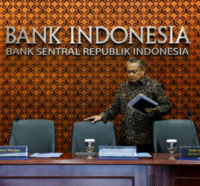
Bank Indonesia raises policy interest rates by 50 basis points on Wednesday
Bank Indonesia raised its policy interest rates by a larger-than-expected 50 basis points at a policy review on Wednesday. Read more.
Summary: This is the first time in two years that rates have been raised, and it comes as Bank Indonesia seeks to bolster the beleaguered rupiah. On Wednesday morning, the rupiah fell to a record low of 17,745 per dollar due to investor concerns about the fallout from the Iran war, unease over the Indonesian government’s ambitious spending plans, and the independence of the central bank. The rupiah currently ranks as among the worst-performing currencies in emerging Asia.
STRATEGIC INSIGHT
Investments in AI had an outsized impact on global trade in 2025. Shipments of the hardware needed to develop and run the technology increased by almost 40 percent during the year, accounting for about a third of global trade growth. The rapid buildout of data centers required large volumes of semiconductors, servers, and networking equipment from tightly linked supply chains running through Taiwan, South Korea, and parts of ASEAN. Research by the McKinsey Global Institute finds that trade flows between the US and Asian economies will drive most of the activity in semiconductor manufacturing.
Annualized goods trade growth by industry group and region, 2024-2025 (%)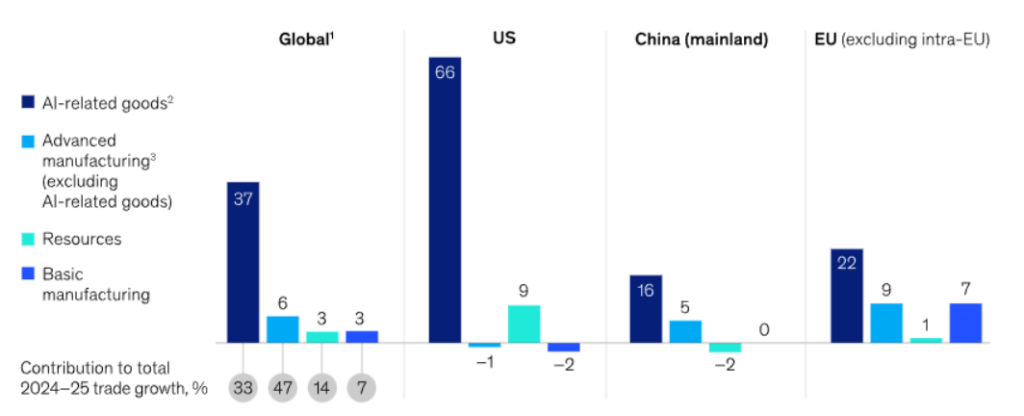
- Estimated from trade data from a panel of large economies, including ASEAN, Brazil, mainland China, EU, India, and the US, all of whom account for 90% of global goods trade. For AI-related goods specifically, estimates includes all major Asian economies.
- AI-related goods includes semiconductors, graphic cards, routers, and servers, which can be used for non-AI applications.
- Advanced manufacturing includes automotives and transport equipment, chemicals, electronics, machinery, medical and scientific equipments, and pharmaceuticals products.
THE WEEK AHEAD: STRATEGIC WATCHLIST
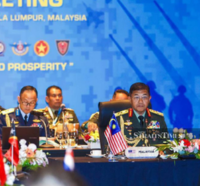
2nd Meeting of the ASEAN Senior Economic Officials (SEOM) (27 May - 2 June 2026)
Why it matters: SEOM typically provides a forum for ASEAN senior economic officials discuss their proposed agenda and review the status of priority economic deliverables.
Source: ASEAN 2026 Events
FEATURED COMMENTARY

by Dr. Mikhail Rosli
Senior Researcher of SEAFIC
Author of SEAFIC-ASEAN Monitor: The Iran Conflict - ASEAN Supply Chain Vulnerability
It is tempting to think of the Hormuz-Strait crisis as an oil crisis. But for Malaysia and ASEAN, it is better understood as a supply crisis. The more useful question is not only whether oil and gas prices rise, but where the shock actually lands once it enters the economy.
This comes with caveats. The 1973 oil shock hit a Malaysia that was still a net oil importer and had limited fiscal cushions. Inflation surged and growth slowed sharply. By 1979, the same type of global shock produced a different outcome because Malaysia had become a net oil exporter and had built a stronger hydrocarbon revenue base. Shocks matter, but fundamentals decide how they are felt.
In Malaysia today, the shock is partly hidden by subsidies. Pump prices can be managed, but input costs still move upstream. The pressure enters through refineries, LPG, petrochemicals, fertiliser and feed, then shows up in transport, packaging, agriculture and food production. This is why the relevant stress points are not only petrol stations or supermarkets, but refinery gates, fertiliser plants, urea terminals and feed mills.
For ASEAN, there is no single Hormuz problem. Thailand, Malaysia and Brunei face a refining-linked problem. The Philippines faces a manufacturing-input problem through chemicals, plastics, metals and electronics. Indonesia faces more of a fuel, freight and logistics problem. Cambodia and Laos may look less exposed at the border, but some of their risk arrives indirectly through Thailand.
To unpack these channels in detail, SEAFIC has released a new report on the Hormuz shock and ASEAN supply-chain exposure. There I trace how Gulf-linked inputs move through Malaysia and the wider region, and why some vulnerabilities only become visible once we look beyond border trade.
Read the full report here
