

THE PAST WEEK

Vietnam to stick to 10 percent growth target for 2026
Vietnam will stick to its 10 percent growth target for 2026 despite a widening trade deficit and inflationary pressures, according to its deputy finance minister. Read more.
Summary: Vietnam’s trade deficit is believed to have reached USD 15 billion in the first half of 2026, swinging dramatically from a trade surplus of USD 7.6 billion in the same period last year. This is largely attributed to higher fuel import costs caused by the war in Iran. Annual inflation also reached 5.6% in May, higher than the government's full-year target of 4.5%.
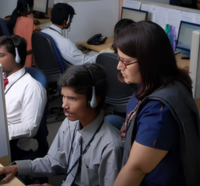
Indian companies invest more than USD 3 billion and create over 30,000 jobs in Malaysia
According to the Consortium of Indian Industries in Malaysia (CIIM), Indian companies have invested more than USD 3 billion in Malaysia, while creating more than 30,000 direct jobs. Read more.
Summary: Malaysia and India have elevated their ties to a Comprehensive Strategic Partnership, while a series of high-level visits in recent years have further strengthened cooperation in trade, investment, education, technology, culture and people-to-people exchanges.
Image: The Exchange Asia
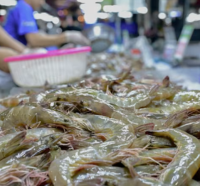
Thai shrimp exporters and farmers impacted by Malaysian ban on Thai shrimp and seabass exports
Shrimp exporters and farmers in southern Thailand, as well as seafood sellers in Malaysia, are grappling with uncertainty after Malaysia banned the import of several Thai shrimp and seabass. Read more.
Summary: The spat started in May when Thailand restricted the import of Malaysian sea bass due to concerns about chemical residues in the fish. Malaysia responded by introducing a temporary ban on 01 June on the import of five varieties of prawns and shrimp from Thailand over food-safety controls. In response, Thailand’s Deputy Prime Minister and Commerce Minister Suphajee Suthumpun stated that Thailand would consider raising the matter at a regional level or at the World Trade Organization if bilateral negotiations do not produce a resolution. Malaysia imports an estimated 6,000 to 8,000 tonnes of Thai shrimp annually, representing around 5% of Thailand’s total shrimp exports.
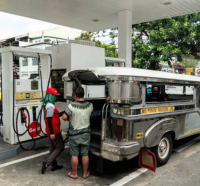
Decline in oil prices expected to offer little respite for Filipino consumers
The recent decline in global oil prices is expected to offer little immediate respite for Filipino consumers, with domestic oil prices expected to take between six to 12 months to normalise. Read more.
Summary: The Philippines remains among the most vulnerable to the global energy crisis, given that the country sources nearly all of its oil from the Middle East. Filipino households have been forced to curtail spending in the face of a spike in energy prices, with household spending expanding at its slowest pace in 16 years outside the pandemic last quarter. In response, the government is considering a supplemental budget while a Senate ad hoc committee is pushing for another PHP 7.5 billion in monthly aid for minimum-wage earners.

Singapore’s labour market softens in first quarter of 2026
Singapore’s labour market softened in the first quarter of 2026, with job vacancies declining to 73,300 from 77,700 in December last year and 80,100 a year earlier. Read more.
Summary: The vacancy-to-unemployed-person ratio fell to 1.46 from 1.58 in the previous quarter, while retrenchments increased to 3,830 from 3,690 in the fourth quarter of 2025, the highest quarterly level since the third quarter of 2023. Despite this, total employment grew by 9,400, extending a streak of 18 consecutive quarters of expansion.
Bank Indonesia raises key interest rate for third time in about a month
On 18 June, Bank Indonesia raised its key interest rate for a third time in about a month, as it seeks to stabilise the rupiah and shore up investor confidence. The benchmark BI-Rate was raised by 25 basis points to 5.75%. Read more.
Summary: The rate hike on 18 June follows Bank Indonesia’s surprise hike on 9 June and a bigger-than-expected 50 basis point increase in May, bringing total tightening to 100 basis points this year. While the rupiah has made recent gains due to intervention by the central bank, investors warn these gains may be temporary unless monetary tightening is supported by more consistent and market-friendly policy adjustments, including efficient fiscal spending, clearer communication, and a more predictable regulatory environment under President Prabowo Subianto.
STRATEGIC INSIGHTS
According to research by Deloitte, approximately 397 MW of data center capacity is expected to go online by 2028, while total capacity will quadruple from 1.68 GW in 2024 to 7.59 GW in the long term. While Singapore currently possesses the largest data centre capacity within Southeast Asia, this position is likely to be supplanted by Malaysia and Indonesia, which are benefiting from Singapore’s limited land capacity (which thus hinders the expansion of Singapore’s supply capacity). Malaysia, in particular, is demonstrating a robust future supply pipeline, with its southern state of Johor becoming one of the fastest-growing markets.
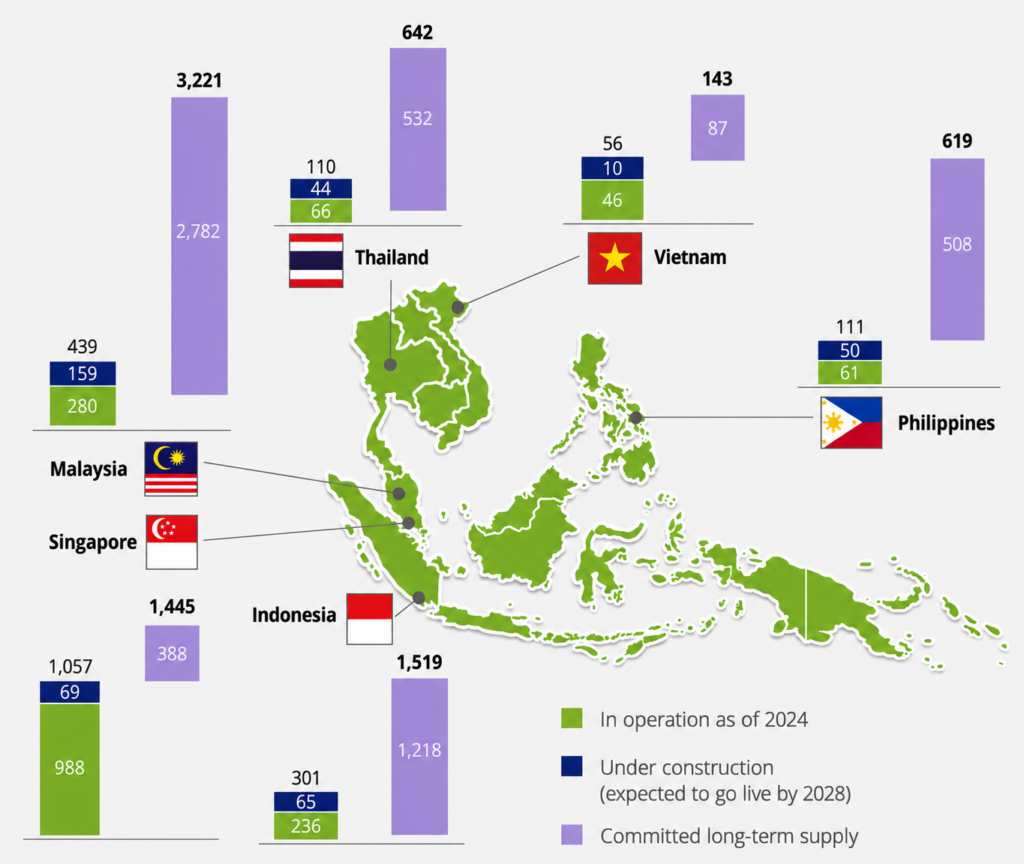
Source: Deloitte, “Southeast Asia’s data centres and AI infrastructure imperative: Capitalising on a once-in-a-generation opportunity”, September 2025.
THE WEEK AHEAD: STRATEGIC WATCHLIST

Next meeting of the Bank of Thailand’s Monetary Policy Committee (MPC) (24 June 2026)
Why it matters: The Bank of Thailand’s Monetary Policy Committee will meet next week with inflation having unexpectedly fallen in May. That month, the consumer price index rose 2.79% year-on-year, decelerating from 2.89% in April. April and May rates marked a sharp turnaround from the prolonged period of falling prices that persisted through much of 2025 and early 2026. Inflation still remains within the Bank of Thailand’s 1%–3% target range, with the Commerce Ministry expecting inflation to breach the central bank’s target range in the second half of this year. The Bank of Thailand has insisted that price increases are temporary, and that monetary tightening will do little to address a supply-driven shock.
Source: Thailand’s Inflation Unexpectedly Eases, Remains in Target Range - Bloomberg
2026 US-ASEAN SME Workshop Series in the Philippines (24 June 2026)
Why it matters: SMEs are the backbone of the Southeast Asian economy, and this programme is part of ongoing ASEAN initiatives to build SME resilience as digital integration accelerates in the age of AI. It focuses on helping them navigate global business landscapes and leverage the growing regional digital economy, while aligning with the ASEAN Digital Economy Framework Agreement (DEFA). The event also aims to support smaller firms in adapting to new digital trade and AI realities, strengthens their ability to compete across borders, and reinforces ASEAN’s broader push for a more connected, resilient digital economic region.
Source: 2026 US-ASEAN SME Workshop Series in The Philippines
89th Meeting of the ASEAN Committee on Science, Technology, and Innovation (COSTI-89) in Vientiane, Laos (22 - 26 June 2026)
Why it matters: The gathering focuses on turning the ASEAN Action Plan on Science, Technology, and Innovation (2026-2035) into a concrete cooperation on energy transition, circular economy, advanced agriculture, and emerging technologies. Besides that, it also aims to build a regional STI ecosystem to accelerate ASEAN’s effort in clean energy while keeping member states aligned with shared standards in the action plan.
Source: 89th Meeting of the ASEAN Committee on Science, Technology and Innovation (COSTI 89)
