
NEW PUBLICATION
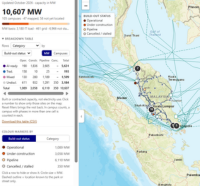
SEAFIC maps Malaysia’s data center expansion.
An interactive tracker provides policymakers and industry stakeholders with a clearer picture of Malaysia’s growing data centre capacity.
Summary: SEAFIC has launched an interactive map tracking Malaysia’s data centre development, from project announcements to full operation. Updated quarterly, the tracker draws on publicly available information, including company announcements, regulatory filings and government statements.
The tracker records each project's capacity in megawatts (MW), development status and category (AI-ready or conventional computing). Users can also examine electricity transmission infrastructure and submarine cable landing points.
The map helps policymakers assess infrastructure readiness and allows industry operators to identify areas of concentrated development, potential constraints and future investment opportunities.
See more: Data Center Mapping
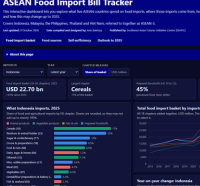
ASEAN Food Import Bill Tracker by SEAFIC.
SEAFIC introduced an interactive dashboard to examine selected countries in Southeast Asia’ food import spending, supplier dependence and self-sufficiency.
Summary: SEAFIC has developed an interactive dashboard that tracks food import spending, sourcing patterns and domestic food production across five Southeast Asian economies: Indonesia, Malaysia, the Philippines, Thailand and Viet Nam, collectively referred to as ASEAN-5.
The tracker covers 18 chapters of the Harmonized System (HS 02–04, 07–12, and 15–23), allowing users to analyze food import expenditure, commodity types, and supplier countries. Users can examine data for individual countries or view the ASEAN-5 collectively, to identify food self-sufficiency, import dependency and baseline projections for production, consumption and trade up to 2035.
By presenting import trends alongside domestic food production and consumption indicators, the tool helps researchers, policymakers and businesses assess regional food security and identify potential vulnerabilities in supply chains. Users can examine resilience on individual trading partners and consider how disruptions such as droughts, export restrictions or shipping interruptions could affect food supplies. The dashboard aims to establish a shared evidence base for discussions on food security, trade dependence and the resilience of food systems across the region.
See more: ASEAN Food Import Bill
THE PAST WEEK

Malaysia’s Diversified Economy To Cushion External Shocks in 2027.
Malaysia’s diverse industries, broad export markets and fiscal reforms are expected to strengthen its resilience against global economic uncertainty. Read more.
Summary: Malaysia is preparing to navigate a more uncertain global economic environment by broadening its industrial base, strengthening trade links and improving its ability to respond to financial pressures, said Finance Minister II Datuk Seri Amir Hamzah Azizan.
Speaking at the International Monetary Fund (IMF) – World Bank Group Annual Meetings in Bangkok, Amir Hamzah highlighted that Malaysia’s total trade rose 27 percent in the first eight months of 2026 compared with the same period in 2025. The economy has expanded beyond commodities and oil and gas into electrical and electronics, semiconductors, data centres and advanced manufacturing. No single export market accounts for more than 17 percent of exports, giving businesses greater flexibility to redirect trade towards stronger-performing markets.
The government is also strengthening domestic industrial supply chains to reduce exposure to international disruptions, while fiscal reforms have improved its capacity to respond to economic shocks. Government-linked investment companies are being encouraged to complement public funding with private investment in strategic domestic industries. Malaysia recorded RM431.8 billion in approved investments in 2025, with domestic and foreign investments contributing approximately equal shares. These measures aim to reinforce the country’s position amid geopolitical tensions and shifting global trade patterns.
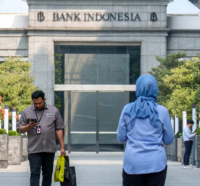
Bank Indonesia's independence is questioned as MSCI signals a downgrade.
A revised mandate, heavy bond buying and an index warning have put Jakarta's monetary credibility in play. Read more.
Summary: Investors want evidence of Bank Indonesia's (BI) independence after index compiler MSCI said on 16 October 2026 that Indonesia no longer merited emerging-market status, citing significant concerns about market dysfunction, suspected coordinated trading behaviour and a lack of meaningful enforcement. The statement came a month ahead of a scheduled review, and MSCI had flagged opacity in shareholding structures in January 2026.
Destry Damayanti, acting governor from late July 2026 and formally appointed in September, said the bank has full authority over interest rate decisions while maintaining synergy with the government. A June 2026 revision to the financial sector law added support for growth and job creation to BI's duties. BI bought nearly IDR300 trillion of government bonds between January and 30 September 2026. The policy rate was held at 5.75% in September after 100 basis points of increases between May and June, and the rupiah traded near 18,070 to the dollar on 16 October 2026.
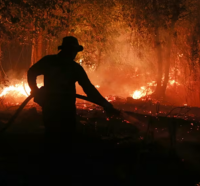
Singapore serves haze prevention notices on seven companies in Indonesia.
Enforcement is reaching across the border at concession holders, and fines remain under consideration. Read more.
Summary: Singapore's National Environment Agency (NEA) will issue preventive measure notices under the Transboundary Haze Pollution Act to seven companies in Indonesia that its investigations identify as responsible for fires behind the current haze. They are PT Bumi Andalas Permai, PT Bumi Mekar Hijau, PT Paramitra Mulia Langgeng, PT Sumatera Alam Anugerah, PT SBA Wood Industries, PT Hutan Lestari Raya and PT Bangkanesia.
Each notice requires the company to deploy firefighting personnel on land it owns or occupies, stop or refrain from burning there, and submit an action plan to NEA. Grace Fu, Minister for Sustainability and the Environment, said on 16 October 2026 that fines and charges sit within the realm of consideration and that NEA will investigate every company found responsible.
The seven hold industrial timber plantation concessions in South Sumatra and the Bangka Belitung Islands, and three are listed as suppliers to Asia Pulp & Paper. Singapore has offered Indonesia civilian firefighting help and cloud seeding. For ASEAN, the case tests whether one member's law can reach land-use decisions taken in another.

Thailand and World Bank Launch Low-Carbon Initiatives.
A USD 200 million loan, carbon-credit market and industrial investment platform to accelerate clean-energy adoption, attract private investment and create jobs in Thailand. Read more.
Summary: Thailand’s Ministry of Finance and the World Bank have launched a partnership effort to finance low-carbon and clean energy projects, develop a credible carbon market and mobilise private investment. The initiative was announced at the IMF-World Bank Group Annual Meeting in Bangkok on 17 October 2026.
The initiative centres on a USD 200 million World Bank loan to the Export-Import Bank of Thailand (EXIM Thailand), backed by sovereign guarantee, to support energy service companies investing in clean energy and energy efficiency. A separate grant of USD 2.4 million will go towards supporting carbon-market development and a just transition.
Krung Thai Bank and the Stock Exchange of Thailand will help establish mechanisms to aggregate, verify and trade carbon credits, with prospective buyers including Grab and Thai Airways. Meanwhile, PTT, Krung Thai Bank and the Department of Climate Change and Environment will develop blended-finance mechanisms for the I-SPARK low-carbon industrial platform in the Map Ta Phut–Rayong area, targeting bio-based and circular industries. The initiatives aim to reduce energy costs, improve industrial competitiveness and create jobs while drawing private capital into Thailand’s transition towards a low-carbon economy.
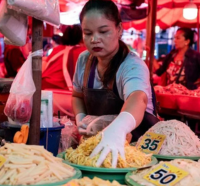
Growth forecasts rise across Southeast Asia while inflation lands on the poorest.
The artificial intelligence boom is offsetting the energy shock in aggregate, though not in household budgets. Read more.
Summary: The Asian Development Bank (ADB) now expects Southeast Asian growth of 4.7% in 2026E, up from the 4.4% it forecast in December 2025, with the upgrade attributed to the artificial intelligence (AI) boom and to supply chains relocating from China. The region draws more than half its crude oil imports from the Gulf, and the shares for the Philippines and Viet Nam exceed 90%; the Strait of Hormuz has been disrupted since the United States attacked Iran on 28 February 2026.
Malaysia, Thailand, Singapore and Viet Nam have gained from electronics demand. The Philippines and the least-developed economies of Cambodia, Laos, Myanmar and Timor-Leste face lower growth alongside higher inflation, with falling reserves limiting their capacity to import. Bangko Sentral ng Pilipinas has raised rates three times without halting the peso's fall to record lows, while Indonesia and Malaysia have held fuel price caps at rising subsidy cost. The shock is landing on household purchasing power while headline output holds up, and poorly targeted subsidies are absorbing the fiscal space a longer disruption would require.
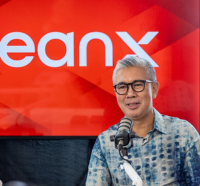
Tengku Zafrul Calls for Stronger ASEAN Integration to Overcome Trade Barriers.
The launch of aseanX highlights the importance of shared information and regional cooperation in helping businesses navigate regulatory hurdles and expand across Southeast Asia. Read more.
Summary: SEAFIC chairman, Datuk Seri Tengku Zafrul Abdul Aziz has called for stronger regional cooperation to unlock ASEAN’s economic potential, highlighting the role of information-sharing in addressing barriers to cross-border trade.
Speaking at the launch of aseanX’s headquarters in Kuala Lumpur on 16 October 2026, Tengku Zafrul described the private regional information platform as a potentially valuable resource for policymakers and businesses seeking to expand across Southeast Asia. He emphasised that access to widely shared, evidence-based information could support better-informed decisions and help address regulatory obstacles that continue to limit regional trade.
He acknowledged that ASEAN members must safeguard their national interests but argued that greater cooperation would strengthen collaboration across the region. The platform aims to bridge Southeast Asia’s information gap by connecting local businesses, policymakers and thought leaders across all 11 markets, including Timor-Leste.
STRATEGIC INSIGHTS
Indonesia's 2026 Fires: Lower Emissions, but Significant Disruption
Indonesia is experiencing one of its worst fire seasons since 2001. Between January 2026 until 19 October 2026, fires released 196.6 million tonnes of carbon according to the Global Fire Emissions Database, nearly three times the historical average. Nevertheless, emissions remain below the levels recorded during the 2015 crises.
Despite lower emissions, the impact on neighbouring countries has been severe. Singapore recorded 14 consecutive days of unhealthy air quality in October, matching the duration of the 2015 episode. In Malaysia, Johor announced the closure of 1,198 schools, affecting more than 617,000 students.
The fires have been concentrated in Kalimantan and Papua, which account for most of Indonesia’s emissions. Beyond public health and education, haze also threatens agricultural productivity. Previous research by MARDI found that prolonged haze exposure could reduce rice yields by 10-19%.
The main concern is that lower fire emissions have not translated into fewer disruptions. Although Indonesia has made progress in reducing burned areas since 2015, the 2026 episode highlights ASEAN’s continued vulnerability to transboundary haze.
Indonesia fire carbon emissions, 2001 to 2026, and the shift
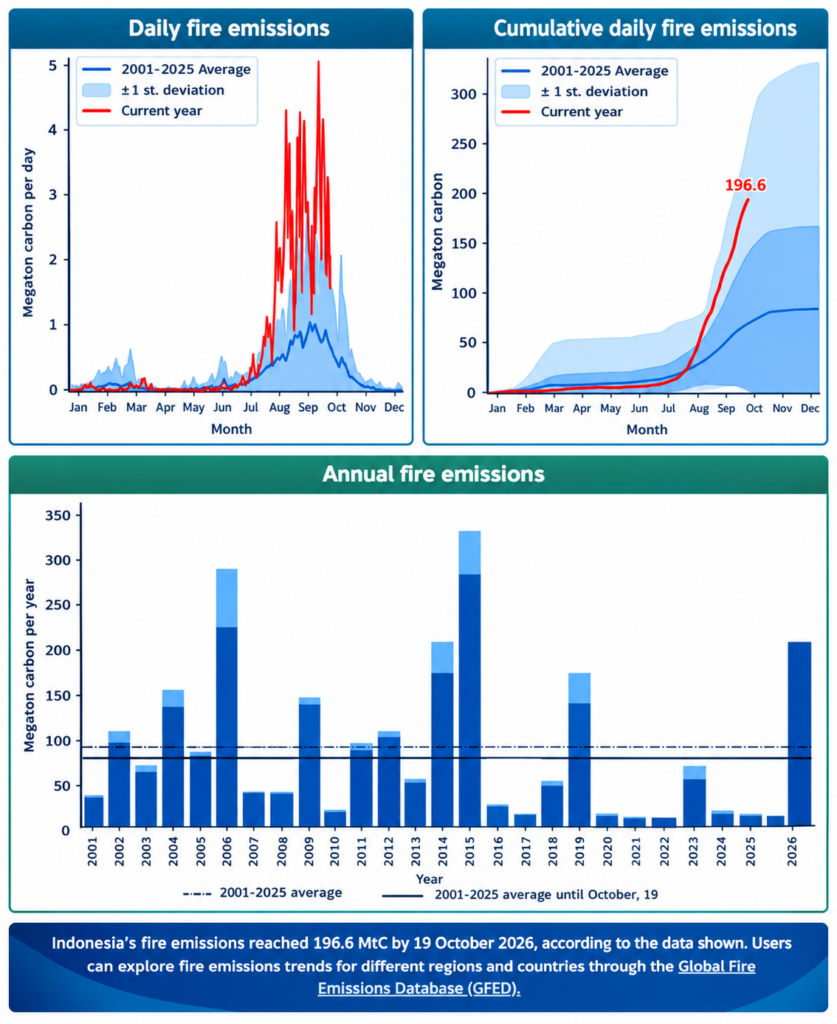
Source: Global Fire Emissions Database
THE WEEK AHEAD: STRATEGIC WATCHLIST
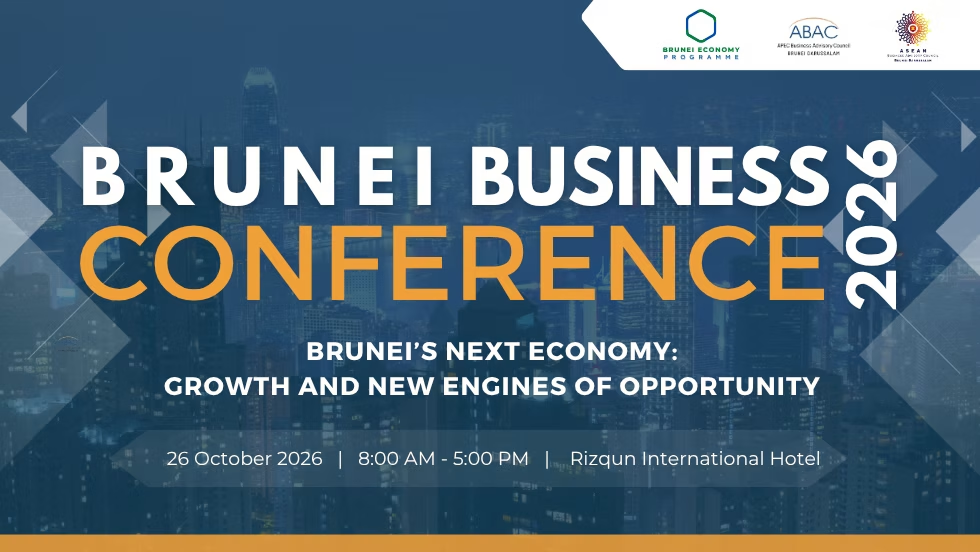
Brunei Business Conference (26 October 2026)
Why it matters: Under the theme “Brunei’s Next Economy: Growth and New Engines of Opportunity,” this conference will gather business leaders, policymakers, investors and regional partners to discuss building a more diversified and competitive economy. Topics include investment, digital transformation and AI, finance, industry and future skills, as well as healthcare and tourism.
The conference will explore Invest Borneo, a platform for Brunei, Kalimantan, Sabah and Sarawak to attract investment and build stronger regional partnerships. Hosted by the ASEAN and APEC Business Advisory Councils of Brunei with the Ministry of Economy, Trade and Industry and UN ESCAP, the conference offers a platform to exchange ideas and build connections that contribute to Wawasan Brunei 2035, the nation’s long-term vision.
Source: Brunei Business Conference 2026
Singapore International Energy Week (SIEW) (26 - 30 October 2026)
Why it matters: SIEW is organised by the Singapore Energy Market Authority (EMA), a statutory board under the Ministry of Energy, Trade and Industry. The event serves as an international platform for professionals, experts, and policymakers to share their insights and collaborate on solutions in shaping the future of the global energy landscape. It will bring together governments, industry leaders and international organisations aimed to examine ASEAN’s energy transition formation, focusing on investment, innovation and integration, with forums alongside the International Energy Agency, the International Renewable Energy Agency and the International Atomic Energy Agency.

ASEAN-Integrated Philippine Semiconductor and Electronics Convention and Exhibition (PSECE) 2026. (26 - 28 October 2026)
Why it matters: Organised by the Semiconductor and Electronics Industries in the Philippines Foundation Inc. (SEIPI) at the SMX Convention Center Manila, the event is timed to the Philippine’s ASEAN chairmanship. The event is expected to discuss the opportunities and challenges shaping the future of the semiconductor and electronics industry. It will convene together manufacturers, technology providers, industry leaders, researchers, and policymakers from across ASEAN and beyond. This agenda emphasises on regional collaboration with engaging discussions on supply chains, workforce development, advancing innovation and enhancing ASEAN’s competitiveness in a rapidly evolving global environment. It includes the ASEAN Semiconductor and Electronics Forum on 26 October, themed “One ASEAN, One Semiconductor Future.”
Women’s International Shipping & Trading Association (WISTA) Annual General Meeting (AGM) & Conference 2026. (28 - 30 October 2026)
Why it matters: The event provides a platform for maritime, shipping and trade professionals to exchange insights on the future of Asia’s maritime industry. Under the theme “Bridging Borders, Driving Change”, the event offers opportunities to build international networks, explore emerging technologies and discuss sustainability challenges affecting shipping and logistics.
For ASEAN, stronger maritime connectivity is essential to facilitating cross-border trade, strengthening supply chains and attracting investment. The conference also encourages collaboration among regional stakeholders, including Malaysia, Singapore and Hong Kong, supporting knowledge-sharing and partnerships that can improve the competitiveness and resilience of Asia’s maritime sector.
Source: WISTA 2026
