

THE PAST WEEK
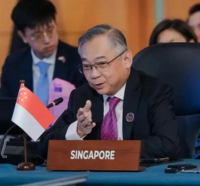
ASEAN must move up the value chain.
Cheap labour won't carry ASEAN much longer, says Singapore's Deputy PM. Read more.
Summary: Singapore’s Deputy Prime Minister Gan Kim Young says that ASEAN faces a challenging path to industrial upgrading as competition intensifies, automation erodes low labour cost advantages, and digital platforms bring both rivals and new markets. At the FutureChina Global Forum, Deputy PM Gan said that trade and investment alone will not suffice; local firms must move up the value chain and workers gain new skills.
China and ASEAN are each other’s largest trade partners, exceeding USD 1 trillion in 2025 and reaching USD 744.4 billion in January-July 2026. The upgraded ASEAN-China Free Trade Area, signed October 2025, offers scope for digital, green, and supply chain cooperation, while links like the International Land-Sea Trade Corridor can help Asean firms reach Chinese customers. Gan added that economies should not mirror each other; the goal is for firms to find their respective niches, and workers see clear progression. This matters as open markets face strain from geopolitical rivalry and growing doubts over fair benefits.
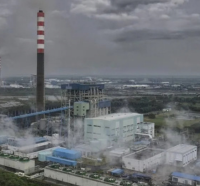
Climate anxiety now rivals economic worry across Southeast Asia.
There is public support for carbon pricing, but far less for measures that raise household costs. Read more.
Summary: ASEAN governments have public backing for market-based decarbonisation and much less for measures that raise household costs. The ISEAS - Yusof Ishak Institute's Southeast Asia Climate Outlook (SEACO) 2026 survey, covering 3,706 respondents across 11 countries and including Timor-Leste for the first time, was fielded over five weeks in June and July 2026. It finds 55.3% naming economic challenges such as unemployment among the region's top challenges and 53.6% naming climate change and extreme weather, a gap of 1.7 percentage points. Support for a national carbon tax stands at 62%, highest in Viet Nam at 83.0%, Indonesia at 72.8% and Thailand at 68.3%, and 93.1% say they would bear a share of the cost. Support for cutting fossil fuel subsidies fell to 41.0% from 43.8% in 2024. The greatest stated fear about moving away from fossil fuels is the cost of living, at 44.6%, followed by energy shortages at 26.1%. For Malaysia and its neighbours, the survey indicates that pricing carbon may meet less resistance than withdrawing fuel subsidies.

Johor-Singapore RTS Link pushed back to February 2027.
Johor retailers lose the Chinese New Year opening they had planned around. Read more.
Summary: The Johor Bahru-Singapore Rapid Transit System (RTS) Link is now expected to open in February 2027 rather than at the end of 2026, missing Chinese New Year on 6 February 2027. In a joint statement on 2 October, both governments said they were working to begin services before Hari Raya Puasa on 10 March 2027. Singapore's Immigration and Checkpoints Authority recorded more than 3 million crossings at the Woodlands and Tuas checkpoints in each of the 2025 and 2026 festive periods, with peaks above 500,000 in a single day. A joint study by the Singapore Business Federation, the Restaurant Association of Singapore and the Singapore Retailers Association projects a 51% increase in outbound trips by Singapore consumers once the link opens. Singapore's vehicle entry permit fees rise to SGD 50 a day for cars and SGD 7 for motorcycles from 1 January 2027, from SGD 35 and SGD 4. For Johor, the delay defers an expected retail uplift while cross-border commuting costs rise, and it adds to a record of Malaysian rail projects completed later than first scheduled.
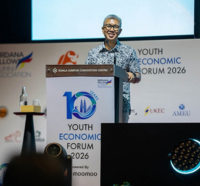
Malaysia shifts from efficiency to resilience amid global uncertainty.
Malaysia’s recorded investments must still deliver better jobs for its youth. Read more.
Summary: At the Youth Economic Forum in Kuala Lumpur on 3 October 2026, SEAFIC Chairman, Tengku Datuk Seri Utama Zafrul Aziz expressed that Malaysia’s economic focus has shifted from pursuing efficiency to building greater resilience, as the country continues to outperform growth forecasts despite global uncertainty. He added that economic leadership means seizing clear opportunities while staying resilient to unpredictable shocks.
He said that fiscal reforms, including fuel subsidy rationalisation and the Fiscal Responsibility Act, have strengthened public finances, but must be matched by compassion: safeguarding the vulnerable while lifting wages alongside productivity, creating higher-paying jobs and boosting entrepreneurship.
Additionally, he noted how shifting trade routes and the rapid development of AI are reshaping the workforce, potentially disrupting traditional entry-level jobs for young people. He argued that Malaysia’s young population could become an economic dividend only if it delivers higher productivity, innovation, high-value jobs and new businesses. He urged Malaysia to keep asking what record investment creates for Malaysians: high-income jobs, skilled young engineers and SMEs in global supply chains. Capital should build stronger firms, and technology better skills.
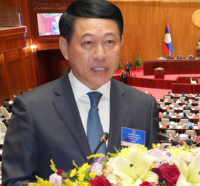
Laos has made a major change in its top leadership.
Laos names Saleumxay Kommasith Prime Minister as Sonexay moves to lead the National Assembly. Read more.
Summary: Laos has appointed Deputy Prime Minister Saleumxay Kommasith as Prime Minister, while outgoing Prime Minister Sonexay Siphandone moves to lead the National Assembly. The leadership changes were approved on 5 October 2026 at the second ordinary session of the 10th Legislature. Saleumxay, a former foreign minister with extensive diplomatic experience, received unanimous support from all 158 lawmakers present. The reshuffle follows the death on 8 August of National Assembly President Xaysomphone Phomvihane, aged 69. National Assembly Vice President Sounthone Xayachack had served as the acting president since 18 August 2026.
The change is the latest in a series of ongoing leadership shuffles including a June 2025 reshuffle of nine senior officials across ministries such as finance and industry and commerce. Further changes are expected in the coming days.
Uranium in Luzon strengthens the Philippines' nuclear fuel ambitions.
A domestic fuel option would change the economics of a 1,200 MW nuclear target. Read more.
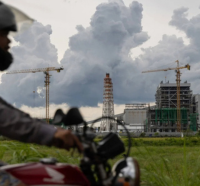
Summary: The Philippines has identified a potential domestic uranium source, although its economic significance is unproven. Researchers from the Philippine Nuclear Research Institute (PNRI), the University of the Philippines Diliman and Akita University confirmed uraninite as the main uranium-bearing mineral in surface samples from the Bessemer area of the Larap-Paracale district in Camarines Norte, and showed the material could be processed towards uranium concentrate.
PNRI said the findings are vital as uranium may become important in the country's foray into nuclear energy, while stressing that detailed geological, radiometric and geophysical surveys and systematic drilling are needed. The Philippines targets at least 1,200 MW of nuclear capacity by 2032 under its long-term energy road map, and the Department of Energy identified seven further potential sites in August across Bataan, Palawan, Masbate, Pangasinan and Camarines Norte. Djoan Kate Tungpalan of UP Diliman argues the country need not build every stage of the fuel cycle, starting instead with domestic mining and processing. For ASEAN, a member state moving towards fuel-cycle capability raises safeguards and regulatory questions the bloc has yet to settle collectively.
STRATEGIC INSIGHTS
Malaysia's grid plan and analysts' data-centre forecasts are a decade apart.
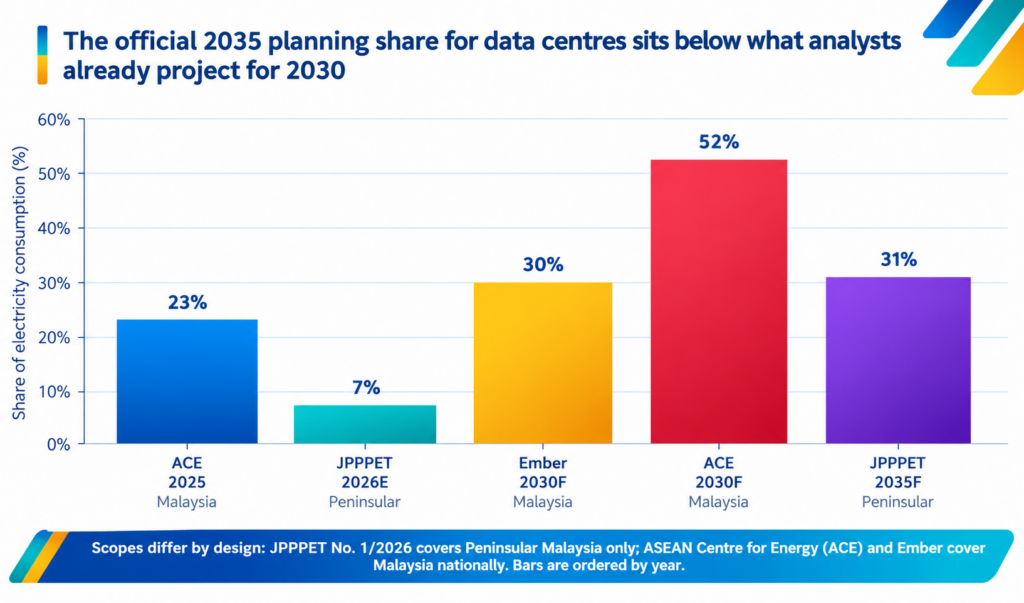
The exposure in Malaysia's data-centre build-out is less the pace of demand growth than the distance between official planning assumptions and independent modelling. The Ministry of Energy Transition and Water Transformation (PETRA), citing the Electricity Supply and Tariff Planning and Implementation Committee (JPPPET) meeting No. 1/2026, told Parliament on 30 June 2026 that data centres account for 7% of Peninsular Malaysia's electricity consumption in 2026, or 10,544 GWh, rising to 31% in 2035, or 73,274 GWh. The ASEAN Centre for Energy (ACE) already places data centres at 23% of national electricity consumption in 2025 and at up to 52% by 2030, while Ember puts the 2030 figure at 30%.
The scopes differ: JPPPET covers Peninsular Malaysia, whereas ACE and Ember cover the country as a whole, so the series are not like for like. The dispersion still matters for procurement. Peak demand in Peninsular Malaysia is officially projected to rise from 21.3 GW in 2026E to 33.5 GW in 2035, a compound annual growth rate of 5.1%, which PETRA attributes to data centres and high-tech industry. Taken together, the two reported pairs imply that data centres would account for roughly three-quarters of all Peninsular demand growth to 2035, a SEAFIC derivation from the published figures that is sensitive to their rounding.
The contracted load is already substantial. PETRA reported that through 1Q2026 Tenaga Nasional Berhad (TNB) was supplying 36 operating data centres with about 4.5 GW of planned supply capacity, with a further 23 projects under construction carrying 3.8 GW of maximum demand. Regionally, ACE puts operational ASEAN data-centre capacity at about 5 GW against more than 50 GW of additional capacity reported collectively by member states, a pipeline roughly ten times what is running.
If the faster path holds, the near-term response is thermal. RMI estimates that a 5 GW round-the-clock base case would require about 3 GW of new combined-cycle gas turbine capacity alongside 2 GW of solar by 2030, and that shifting load in roughly 600 hours a year could defer up to 800 MW of gas and save about USD 90 million. The catalysts to watch are the next JPPPET revision and the coming tariff review. On these numbers, flexibility obligations written into supply agreements are the cheaper hedge against a demand forecast that may prove a decade early.
Source: Parlimen Malaysia
THE WEEK AHEAD: STRATEGIC WATCHLIST

AI and The Future of Capital Markets: Innovation, Development and Trust. (15 October 2026)
Why it matters: This is a joint session by the Asian Development Bank (ADB) and International Organization of Securities Commissions (IOSCO), to be held in Bangkok, Thailand. It will bring together securities regulators, industry participants and World Bank representatives to discuss AI, digitalisation and the future of finance, focusing on innovation and market development.
As ASEAN attempts to deepen its capital markets, this session is expected to test whether regulators can encourage AI-driven innovation without weakening investor trust, and whether ASEAN markets will approach it with coordinated rather than fragmented rules.
Source: AI and The Future of Capital Markets: Innovation, Development and Trust

11th ASEAN Ministerial Meeting on Minerals (11th AMMin) and associated meetings (19 - 23 October 2026)
Why it matters: AMMin is ASEAN's ministerial channel for minerals cooperation, and the 11th meeting will convene in Kuala Lumpur, Malaysia, as critical-minerals policy hardens across the region, with Indonesia, the Philippines, Viet Nam and Malaysia each weighing export controls, downstream processing requirements and partnership terms with buyers outside the bloc. The event will include associated senior-officials sessions, with the 5th ASEAN Mineral Awards to be presented at the meeting’s gala dinner. The meeting will also focus on processing investment or export restrictions, which would bear directly on the value-added and common external tariff debates now being argued in the region.
Source: ASEAN
ASEAN Green Jobs Forum 2026 (2nd ASEAN TVET Policy Dialogue) (19 - 20 October 2026)
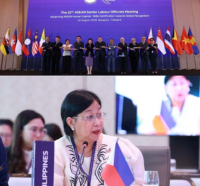
Why it matters: The forum is the green-skills strand of ASEAN labour cooperation, convened at senior-officials level under the Philippines' 2026 chairmanship. It serves as a space where ASEAN Member States and stakeholders can discuss how to put the ASEAN Framework and Action Plan for a Just and Inclusive Transition to Green Jobs into practice, now that it was adopted in March. The dialogue expects to test whether green-jobs ambitions are matched by TVET capacity, which is where energy transition targets meet the labour market. For Malaysia, data-centre and grid construction places the same demand on electrical, instrumentation and civil trades.
Source: ASEAN Green Jobs Forum 2026
