
THE PAST WEEK
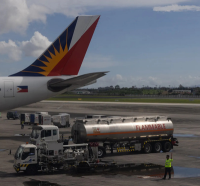
Filipino and Thai companies bear the brunt of earnings downgrades across Southeast Asia
Companies across Southeast Asia are facing earnings downgrades due to higher oil and input prices, tighter margins, and depressed domestic demand. Companies in Thailand and the Philippines are bearing the brunt of these downgrades. Read more.
Summary: The reason that companies in Thailand and the Philippines are the most vulnerable to earnings downgrades is due to both countries’ heavy reliance upon oil and gas imported from the Middle East. More than 90% of the Philippines’ and 60% of Thailand’s oil imports come from the Middle East. The true vulnerabilities of said companies are expected to become clearer in upcoming earnings reports, with second-quarter margins already shrinking. Companies in consumer-facing sectors such as transportation, tourism, and retail remain particularly vulnerable.

Bank Negara Malaysia to boost efforts to encourage greater foreign-exchange inflows
Bank Negara Malaysia will intensify measures to encourage foreign exchange inflows, including a program that incentivizes companies to bring home overseas earnings, as well as greater engagement with government-linked companies and companies on repatriating and converting overseas income. Read more.
Summary: After outperforming all regional peers except the yuan in the first five months of the year, the ringgit has started to come under pressure in June, weakening 4.30% to become Asia’s worst-performing currency amid expectations of higher US interest rates and domestic political uncertainty.

Lazada lays off about 5% of workforce in Southeast Asia
E-commerce platform Lazada said on 23 June that it has laid off some of its workforce after reviewing certain roles in its regional markets, with the layoffs expected to impact about 5% of Lazada’s total workforce in Southeast Asia. Read more.
Summary: While Lazada did not disclose which roles would be impacted, they stated that the review was based on business needs, role requirements, and organisational efficiency. According to consultancy Momentum Works, this restructuring exercise appears to be an effort at organisational optimisation, and suggests that the e-commerce sector in Southeast Asia has matured.
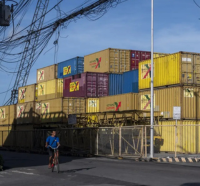
The Philippines and Indonesia to begin talks on joining CPTPP
According to a joint statement from the 12 nations of the CPTPP released by Singapore on 26 June, senior officials have begun preparatory talks with the Philippines and Indonesia about joining the CPTPP. Read more.
Summary: The CPTPP currently includes the ASEAN economies of Brunei Darussalam, Malaysia, Vietnam, and Singapore. It also includes Australia, Canada, Chile, Japan, Mexico, New Zealand, Peru, and the United Kingdom. The CPTPP will also begin preparatory talks with the United Arab Emirates, and has reaffirmed its commitment to formalize the accession of Costa Rica as soon as possible. The trading bloc has also instructed the working group to expedite its work on Uruguay’s application to join.
Image: The Edge Malaysia

Bank of Thailand leave its benchmark interest rate unchanged at 1.00%
On 24 June, the Bank of Thailand’s .Monetary Policy Committee (MPC) voted unanimously to leave its benchmark interest rate unchanged at 1.00%, as widely expected by economists. Read more.
Summary:The MPC stated that the Thai economy is expected to grow at a faster rate than previously estimated, but that the growth rate will be low and uneven. The MPC had raised its forecast for economic growth this year to 2.3%, from 2.0% earlier, but said the figure would slip to 1.8% in 2027, with growth driven by better-than-expected exports and tech-related investments. It also said that inflation will rise due to supply-side factors, before declining as those factors gradually ease. The Consumer Price Index in May rose by 2.8% year-on-year, down slightly from 2.9% in April, as impacts from high energy prices and the Middle East war persisted.

Vietnam pursuing new generation free trade agreements (FTAs) with Middle East and South Asia
Vietnam is seeking new markets to strengthen economic security and improve trade resilience amid global economic volatility, geopolitical tensions and growing protectionism. In this vein, Vietnam has been pursuing international economic cooperation frameworks and new-generation FTAs with the Middle East and South Asia. Read more.
Summary: These include the Vietnam-Israel Free Trade Agreement (Vifta), which came fully into force in 2026, and the Comprehensive Economic Partnership Agreement (Cepa) between Vietnam and the UAE, which took effect in February 2026. Vietnam is also negotiating an FTA with the Gulf Cooperation Council (GCC), as well as participating in a review of the ASEAN-India Trade in Goods Agreement.
STRATEGIC INSIGHTS
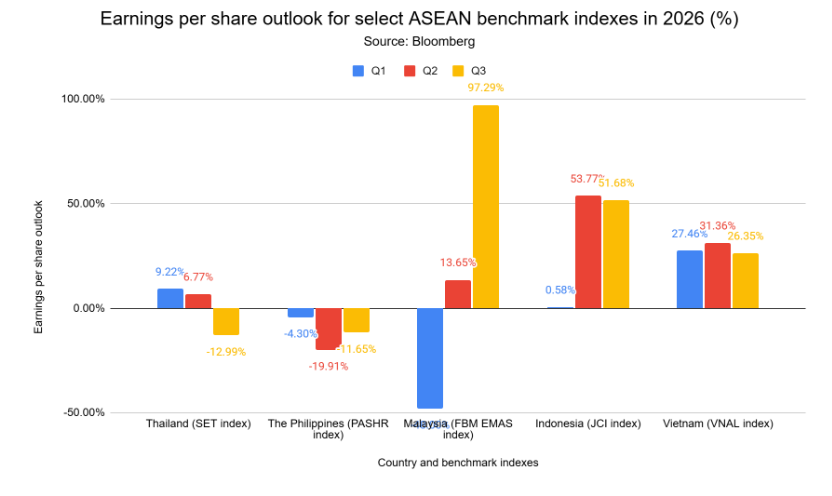
Companies across Southeast Asia are facing earnings downgrades amidst tighter margins, higher fuel or input costs, and softening domestic demand. Companies in the Philippines and Thailand are at particular risk, given that both countries rely heavily on oil and gas transported through the Strait of Hormuz. The vulnerability of said companies is expected to be made clearer in upcoming earnings reports.
Earnings per share outlook for select ASEAN benchmark indexes in 2026 (%)
THE WEEK AHEAD: STRATEGIC WATCHLIST

Resumption of US-Iran technical talks (29 - 30 June 2026)
Why it matters: US Secretary of State Marco Rubio revealed that technical-level talks between the US and Iran will resume in Switzerland around June 29 or 30. The talks are part of a 60-day negotiation process launched under the Islamabad Memorandum of Understanding, recently signed by US President Donald Trump and Iranian President Masoud Pezeshkian. The talks are intended to lay the groundwork for a final accord addressing Iran’s nuclear activities and the future of international sanctions imposed on Tehran. The US and Israel-led war on Iran launched on 28 February, and the resultant closure of the Strait of Hormuz, has had an outsized impact on Southeast Asia, given that the region imports a sizable number of its oil and gas from the Middle East. The global spike in energy prices caused by the war has fueled inflationary and fiscal pressures across the region.
Source: US-Iran technical talks set to resume next week: Rubio - TRT World
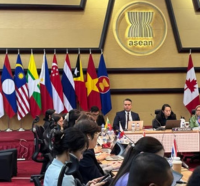
19th ASEAN-Canada Free Trade Agreement Trade Negotiating Committee (ACAFTA TNC) Meetings (29 June - 3 July 2026)
Why it matters: Both ASEAN and Canada are accelerating efforts to conclude the ASEAN–Canada Free Trade Agreement. According to Canadian officials, Canada expects to conclude negotiations over a free trade agreement with ASEAN this year, with negotiations having begun in 2021. The ACAFTA is expected to open doors across strategic sectors such as the digital economy, food and energy security, linking Canada’s tech and resource sectors with Southeast Asian manufacturing. The ASEAN-Canada bilateral trade reached USD 37.5 billion in 2025, a 23% increase from 2024.
Source: [PUBLIC AND DELEGATES' CALENDAR] ASEAN 2026 Notional Calendar

Strategic Breakthrough Summit 2026 (1 July 2026)
Why it matters: Held in Kuala Lumpur, the Strategic Breakthrough Summit is designed to help industry professionals, business leaders, and entrepreneurs harness the power of AI and digital insights.
