SPEECH BY
YB SENATOR TENGKU DATUK SERI UTAMA ZAFRUL TENGKU
ABDUL AZIZ
MINISTER OF INVESTMENT, TRADE AND INDUSTRY
for
ASEAN POLICYMAKERS CONFERENCE ON STEEL &
2025 ASEAN IRON AND STEEL FORUM
&
LAUNCH OF STEEL INDUSTRY ROADMAP 2035
29 September 2025 | Dewan Perdana MITI
YB Liew Chin Tong,
Deputy Minister of Investment, Trade and Industry
YBhg. Dato’ Hairil Yahri Yaacob,
Secretary General of the Ministry of Investment, Trade and Industry (MITI)
YBhg. Datuk Hanafi Sakri,
Deputy Secretary General (Industry), MITI
YBhg. Datuk Lim Hong Thye,
Chairman of South East Asia Iron and Steel Institute (SEAISI)
Distinguished officials from ASEAN Member States as well as Malaysian Government Ministries and Agencies
Captains of industry, respected colleagues, members of the media,
Ladies and gentlemen,
Assalamualaikum warahmatullahi wabarakatuh, Salam Sejahtera, and Salam Malaysia MADANI.
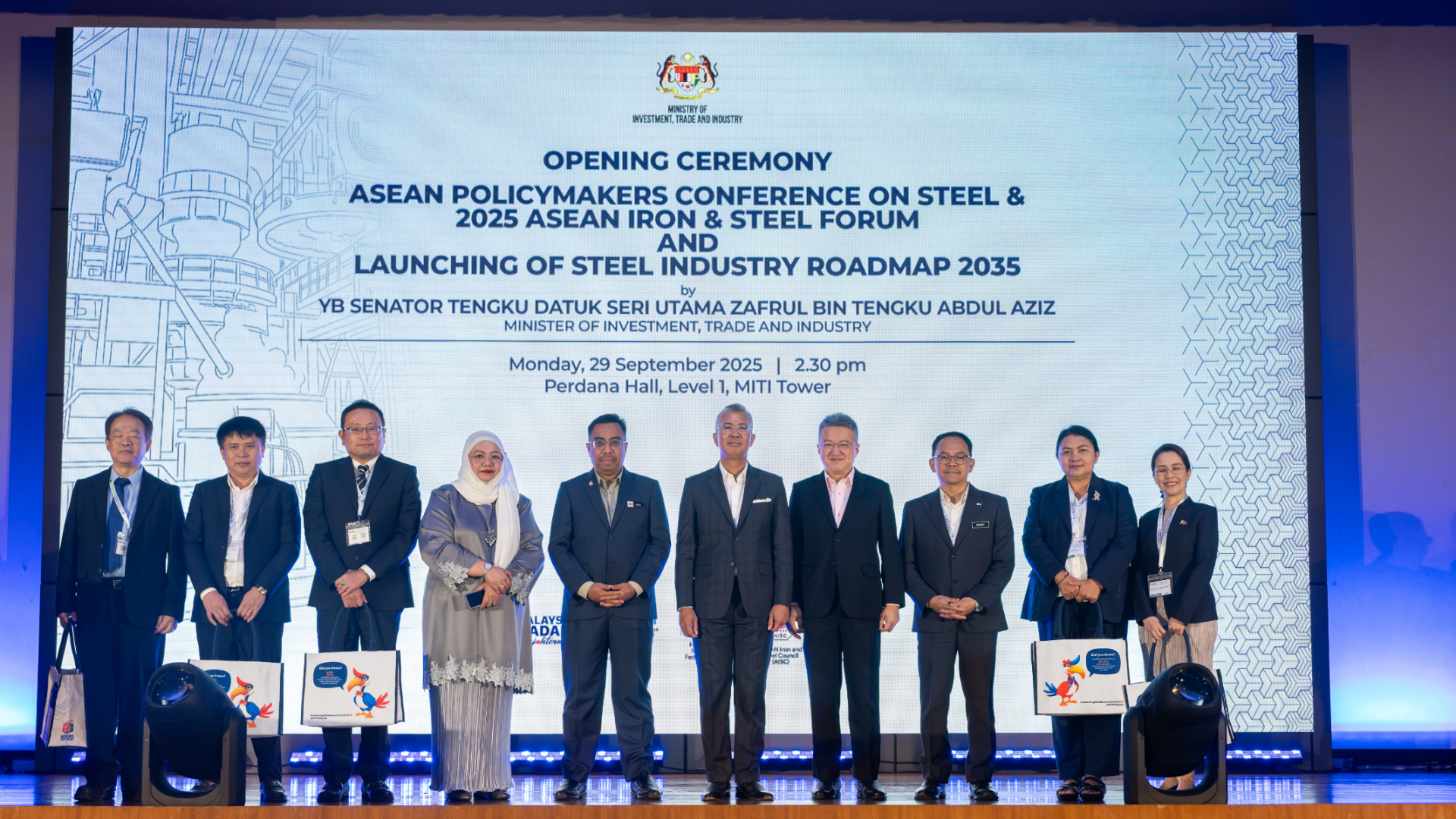
1.Thank you for having me this afternoon, to officiate the opening of the ASEAN Policymakers Conference on Steel and the 2025 ASEAN Iron and Steel Forum. MITI is proud to collaborate with the South East Asian Iron and Steel Institute (SEAISI) on this event to engage with ASEAN policymakers and industry players on current topics impacting the iron and steel industries.
2.This gathering is significant as a dialogue platform and in curating a collective vision for the industry’s future. Today, the Ministry of Investment, Trade & Industry (MITI) will also unveil the Steel Industry Roadmap 2035, outlining the Government’s path to growing the iron and steel sector sustainably.
ASEAN’s Iron & Steel Industry
Ladies and gentlemen,
3.The iron and steel industry has long been the backbone of ASEAN’s industrialisation. Steel builds homes, roads and bridges, vehicles and ships, and the machinery that powers economies. Steel is the foundation of our future industrial growth.
4.Steel demand in ASEAN has grown steadily, with apparent consumption in the ASEAN-6 at 74 million tonnes in 2023, close to the pre-pandemic peak of 80 million tonnes in 2018–2019.
5. But the industry faces pressing challenges. Globally, there is more than 600 million tonnes of excess steelmaking capacity, with much of this surplus seeking ASEAN markets. Within our region, steel demand is projected to reach 80 million tonnes by 2025.
6. Yet the situation is far from ideal: ASEAN faces oversupply in long steel products, while remaining heavily import-dependent in flat steel products. This imbalance distorts our markets and creates an excessive burden to ASEAN’s steel industry.
7. These challenges are further compounded by the introduction of new regulatory measures on decarbonisation and green steel obligations, as well as unfair practices such as dumping and transhipment. The tariff burden, including the US Section 232 tariff on steel and aluminum, will also have serious implications for major ASEAN producers.
8. Steel accounts for a significant share of industrial carbon emissions. It is our collective responsibility — policymakers and industry players —to explore strategies to mitigate these challenges in line with our Net Zero aspirations.
9. But these burdens must not be shouldered by any single country. To effectively address them, countries must collaborate and curate a regional solution. Significance of Conference and Forum
10. This is where this Policymakers Conference is timely and important – as the inaugural ASEAN-level platform for steel policy. Government representatives need to build a shared understanding and explore collective responses.
11. Among the objectives of ASEAN Policymakers Conference on Steel (held in conjunction with the 2025 ASEAN Iron and Steel Forum), are to build a common understanding of the structural and environmental pressures on this industry; and to explore a framework for ASEAN cooperation, so we can compete fairly, transition sustainably and build resilience together.
12. I am pleased to note that the 2025 ASEAN Iron and Steel Forum complements this effort by bringing together industry players, technical experts, and international partners – grounding discussions in policy direction and market realities.
13. Malaysia’s appreciation goes to SEAISI and ASEAN colleagues for making this platform a reality. I was informed that the morning sessions on overcapacity, decarbonisation, and supply chain innovation were productive. These conversations must continue. To that end, let us establish this conference as a regular platform that guides ASEAN steel policy with continuity and purpose.
Malaysia’s Steel Industry Roadmap 2035 (SIR2035)
Distinguished guests,
14. Allow me to share Malaysia’s experience. Malaysia faces a stark imbalance between supply and demand in its steel industry. Domestic projections show upstream capacity could reach 40.8 million tonnes by 2030, while domestic demand is only 14.7 million tonnes.
15. This gap highlights overcapacity—assets underutilised, poor return on investments, and market conditions’ weakening competitiveness and resilience.
16. Sustainability is integral. Steel remains among Malaysia’s most carbon-intensive industries, exposing us to regulatory market barriers and making decarbonisation a necessity, both environmentally and economically.
17. Against this backdrop, MITI formulated the Steel Industry Roadmap 2035 (SIR2035). It provides a sequential pathway to stabilise, restructure, and transform Malaysia’s steel industry, in line with the New Industrial Master Plan 2030, the National Energy Transition Roadmap, and our Net Zero aspirations by 2050.
18. SIR2035 outlines 15 main strategies across three phases. In the immediate term (the next two years), the focus is on stabilisation: managing overcapacity, restructuring licensing frameworks, enforcing discipline against illegal operators, securing domestic raw materials, and laying foundations for decarbonisation.
19. From 2027 to 2035, the Roadmap shifts to transformation: accelerating carbon mechanisms, developing low-carbon production infrastructure and standards, and reinvesting in new technologies to build capabilities.
20. Beyond 2035, the aim is a fully green steel sector by 2050, mobilising talent and capital to keep Malaysia’s steel industry competitive, resilient, and aligned with Net Zero commitments.
21. This means that SIR2035 is not only a policy document; but also a national contract for our sustainable future, as well as future generations’ socio-economic well-being and resilience.
Malaysia’s Contribution to ASEAN’s Framework on Regional Cooperation.
22. Malaysia recognises that our national roadmap should also contribute to ASEAN’s sustainability efforts. To that end, I would like to propose a regional cooperation framework for ASEAN Member States’ consideration:
i. First, in collaboration with SEAISI, we should establish an ASEAN database on capacity and utilization. This will enhance market transparency and guide coordinated responses to address overcapacity, dumping and transshipment.
ii. Secondly, development of a common decarbonisation pathway, including full MRV (monitoring, reporting, verification) and EPD (environmental product declarations), along with harmonised green steel standards.
iii. Third, to safeguard regional scrap flows, ASEAN Member States should explore DRI/HBI1, probably green DRI hubs and related renewable-energy infrastructure.
23. Through these tracks, ASEAN can lead the green industrial transition. As Malaysia nears the end of our ASEAN Chairmanship, we hope for a clear, transparent pathway from ASEAN Members to prepare our industry for future uncertainties.
Closing and Launch
Distinguished guests,
24. Our steel industry stands at a crossroads. The choices we make today will determine whether ASEAN’s steel sector becomes a driver of growth, resilience and sustainability, or remains burdened by old challenges.
25. Malaysia looks forward to partnering with ASEAN to move from plans to performance, from aspirations to actions. Together, we can forge an ASEAN steel industry that is competitive, fair, and future-ready. On that note, it gives me great pleasure to officially declare the ASEAN Policymakers Conference on Steel and the ASEAN Iron and Steel Forum 2025 open, and to launch Malaysia’s Steel Industry Roadmap 2035. Thank you. Terima kasih.
Loading Viewer...
