
THE PAST WEEK

SEAFIC Chairman and APPGM-SDG engages with the Community – Urban Squeeze: Raising the Floor for Economic Security and Mobility in Malaysia
The Southeast Asian Futures Initiative Centre (SEAFIC), in collaboration with All-Party Parliamentary Group Malaysia on Sustainable Development Goals (APPGM-SDG) and My SDG Centre for Social Inclusion, convened a focus group discussion on economic security and mobility in the Klang Valley today. Read more.
Summary: Among the concrete outputs was a closed-door focus group of 15 participants across five demographic groups which were fresh graduates, heads of household, working single mothers, gig workers, and senior citizens. This was to map B40/M40 economic security in the Klang Valley, Malaysia. The session produced a specific diagnostic reframing: housing, while the largest budget line, was identified as predictable and therefore manageable, whereas unplanned volatility in transport, food, and utility costs was named as the actual binding constraint on household stability.
A policy gap was also flagged for M40 households, who face B40-level daily pressures but sit outside targeted assistance eligibility, particularly where life-stage costs (school-age children, aging parents, health shocks) aren't factored into income-bracket classification. The session closed with four structural recommendations: expanding housing eligibility and siting near employment centres, decoupling food subsidies from other costs while extending them to wet markets, building portable-credential pathways out of gig work, and aligning curricula with labour market demand.
Practically, the session functions as an input into APPGM-SDG's parliamentary advocacy and SEAFIC's broader "raising the floor" series (following an earlier commentary of the same title and the Roundtable #2 on ASEAN jobs), positioning it as agenda-setting groundwork for a better sustainable economic development.

Singapore will probe any tariff evasion, PM says in response to Trump
Singapore PM Lawrence Wong said Singapore will investigate companies suspected of using the city-state to evade US tariffs, as Washington increases scrutiny of transshipment and trade-rule violations. Read more.
Summary: Singapore Prime Minister Lawrence Wong said the country will investigate companies that use Singapore to circumvent US tariffs or import goods produced with forced labour, while acknowledging that enforcement must be realistic given the enormous volume of trade passing through the city-state.
His comments come as Washington intensifies scrutiny of transshipment, particularly the routing of Chinese goods through third countries to avoid US duties. The US estimates that tariff evasion through transshipment could cost it US$19–26 billion in lost tariff revenue annually.
Meanwhile, Singapore is facing a 12.5% US tariff on selected exports, effective from July 24 because it determined that Singapore had not adopted an import prohibition on forced-labour goods.
The tariff affects around S$9.5 billion (US$7.4 billion), or one-third of Singapore's domestic exports to the US. Wong's remarks therefore highlight Singapore's challenge of maintaining its open, trade-dependent economy while tightening supply-chain controls to address growing US concerns over forced labour and tariff evasion.
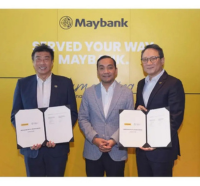
Johor-Singapore SEZ draws RM126.9b in FDI — Johor CM
The Johor-Singapore SEZ has attracted RM126.9 billion in FDI, boosting cross-border manufacturing expansion. Read more.
Summary: The Johor-Singapore Special Economic Zone (JS-SEZ) has attracted a record RM126.9 billion in foreign investment since its establishment, signalling strong investor interest in the cross-border economic hub.
A new partnership between Maybank and the Singapore Manufacturing Federation aims to encourage more Singaporean manufacturers to expand into Johor, leveraging Malaysia’s lower-cost resources while retaining headquarters and key operations in Singapore.
The JS-SEZ’s upcoming masterplan will focus on speeding up investment approvals, improving the movement of goods and people, and attracting higher-value industries.
With more than 700 businesses already engaged by the Singapore Manufacturing Federation, the zone is increasingly positioned as a platform for Singaporean firms to scale into Malaysia and the wider ASEAN market. The partnership also seeks to support SMEs through financing, sustainability initiatives and cross-border banking services.
ASEAN headlines India's export expansion in April-June quarter
India's merchandise exports to ASEAN surged 61.6% to $14.61 billion in the April-June quarter, though analysts attribute most of the growth to elevated petroleum product prices rather than deeper trade integration or tariff preferences. Read more.
Summary: India's merchandise exports expanded 15.9% in the April-June quarter, with ASEAN accounting for approximately one-third of the total increase in value, reaching $14.61 billion and rising 61.6% year-on-year. Singapore and Malaysia led this growth, with exports rising 101.2% to $6.52 billion and 75.2% to $2.54 billion respectively.
However, analysts emphasize that commodity price fluctuations significantly inflated these headline figures. When excluding petroleum products like diesel and aviation turbine fuel, ASEAN export growth falls to 27.4%, compared to the headline 61.6% figure.
The surge occurs amid ongoing negotiations to revise the ASEAN-India Trade in Goods Agreement (AITIGA), which began formally in May 2023. Experts argue that tariff preferences play a limited role, as Singapore already applies zero tariffs to approximately 99% of products and Malaysia provides duty-free access to over 80% of items.
India is pushing for greater market access and updated rules of origin provisions to prevent Chinese goods from being rerouted through India into the bloc. The expansion reflects both strengthened trade ties and favorable global commodity conditions.
The 61.6% export surge reflects nominal values (quantity × price at current prices). Since petroleum products—which saw higher prices due to supply disruptions—accounted for much of the increase, the volume of actual goods exported grew far less dramatically.
For explanation of how export value is calculated, see: https://www.bls.gov/opub/hom/ipp/concepts.htm

Singapore vows to strengthen Asean unity and deepen regional integration
Singapore has promised to do everything in its power to strengthen ASEAN centrality and unity, in hopes to create a more single, effective market for the region. Read more.
Summary: Prime Minister Lawrence Wong has stated that Singapore will continue to strengthen partnerships through bringing diverse partners together, building common ground and keeping channels for cooperation open between ASEAN and other regions.
This is in order to face the global environment challenges resulting from West Asia conflicts. Wong has emphasised on the fact that Singapore must be able to hold their own in the case where West Asia conflicts escalate beyond the current situation.
Simultaneously, Singapore plays a significant role in the global supply chain, being labelled as a major business and finance hub. Thus, Wong also emphasised that Singapore intends to increase its relevancy by connecting with more partners, in order to provide more opportunities for locals.
Wong outlines the support given to the locals, touching on initiatives made to support local Singaporean families such as childcare leave, higher income ceilings and major industrial development plans for many different areas in Singapore.

AI, energy security needs are driving surge in South-east Asia’s energy infrastructure deals
Deals in areas of power generation, infrastructure and data centres have risen in 2026, surging the values of these deals to US$9.2 billion in Q1 2026. Read more.
Summary: Due to an AI boom and an increase of data centre investments, energy infrastructure deals in Southeast Asia have reached a value of US$9.2 billion in Q1 2026, 2.5 times higher year-on-year.
The most notable examples are Malaysia which recorded the largest year-on-year increase of US$5.3 billion and Singapore which had the highest valued deal in 2025 of US$7 billion.
However, geopolitical disruptions such as the war in Iran have stunted the accessibility of energy, increasing the financing costs behind deals and energy prices. This has caused governments to quickly approve projects amid said higher financing costs.
These geopolitical conflicts have added an element of urgency towards acquiring these resources, forcing the issue of energy security to rise on top of the agenda. This has also forced companies within Southeast Asia to seize other energy related facilities and companies and resources in other regions not limited to Southeast Asia.
Furthermore, increased investment of datacentres and other energy-related projects such as electric vehicles have created a higher demand for gas to generate said power and electricity needed for these projects.
However, due to the shortage of gas supply, instead, investment for renewable energy has accelerated, considering it is less complex and faster to build compared to gas plants.
Specifically, investors are looking into the role of geothermal infrastructures and solar-paired battery storages. These resources represent renewable deals that can generate power reliably.
Meanwhile, electricity grid infrastructure remains both the biggest need in ASEAN but also the hardest to invest in due to high capital requirements and transmission output. Thus, the ASEAN Power Grid (APG) initiative, intended to connect electricity networks of Southeast Asia countries.
The initiative is aimed at boosting energy security, sharing renewable resources, supporting multi-lateral power trade and has currently reached about 7.7 GW of cross-border interconnection projects, targeting 17.6 GW by 2040.

Southeast Asia to deliver less than one-third of planned gas power capacity by 2030
Growing obstacles towards the online opening of Southeast Asia’s expected 53GW gas-fired power pipeline reflects a gap between government ambitions and project execution, resulting in only 14.9GW being available to reach commercial operation. Read more.
Summary: Whilst governments have targeted approximately 53GW of new gas-fired capacity, Wood Mackenzie has forecasted only one-third of the planned gas power by 2030.
This is due to issues of volatile fuel cost, equipment shortages, financing constraints, and infrastructure bottlenecks that have delayed the development of the project, implying issues deriving not from planning power but execution power.
Furthermore, only 11GW of the planned gas-to-power pipelines have managed to secure gas turbines whereas the rest of the planned capacity will face delivery lead times of another 5 years.
However, despite this, electricity demand is expected to grow by 2.4 fold by 2050, driven by an industrial expansion and increased investments in areas like hyperscale datacentres and semiconductor productions.
Simultaneously, gas demand is also expected to more than double between 2026 and 2050. Along with that, Southeast Asia is expected to become a net gas importer by 2033, with LNG supplying upwards of 80% of regional gas demand by 2050.
Nonetheless, gas-power expansion faces not only turbine shortages but LNG infrastructure, financing, permitting and equipment delays. These obstacles have caused policymakers to rethink the traditional role of gas as a key enabler of Southeast Asia’s energy transition that supported the maintenance of energy security and integration of renewable energy.
Thus, the use and role of gas continues to waver, as faith in the resource has forced Southeast Asia to reconsider their short and long-term energy strategy.
STRATEGIC INSIGHTS
ASEAN+3 Macroeconomic Research Office (AMRO) in its July 2026 quarterly update reveals something structurally important: AI has moved from being a growth contributor to being the region's primary growth variable, and three points from the update stand out.
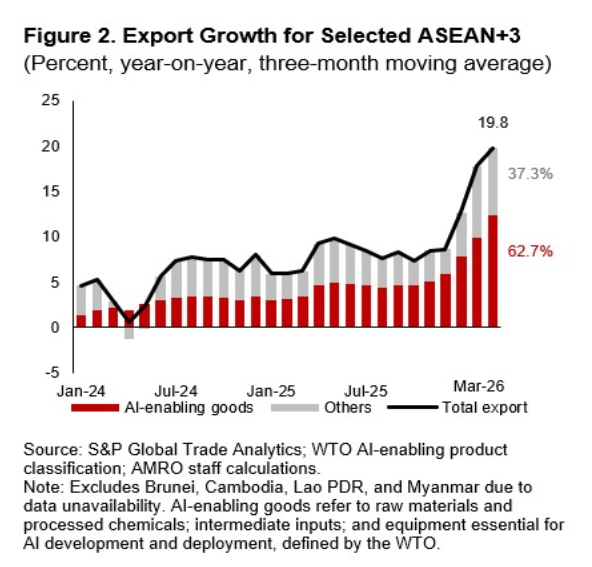
The first is that concentration risk in the region is now macro-systemic rather than sectoral. Around half of global AI-related trade runs through ASEAN+3, and AI-related exports contributed roughly two-thirds of export growth in the first quarter of 2026. This is no longer a story confined to Korea's or Taiwan's chip sector but it is a regional macroeconomic dependency. When one input category, AI-linked semiconductors and hardware, drives two-thirds of export growth across an entire economic bloc, a slowdown in that single vertical stops being a firm- or country-level correction and becomes a region-wide shock.
The second is that the current upswing is substantially a memory-price cycle, and price cycles of this kind are inherently unstable. The export acceleration has been driven largely by the global memory cycle: semiconductor sales nearly doubled in the first five months of the year, reflecting a sharp rise in memory prices amid capacity constraints tied to AI infrastructure buildout. Price-driven surges rooted in capacity constraints are classically mean-reverting, which means AMRO's upward growth revision to 4.1 percent is riding a cyclical price spike as much as it reflects genuine demand expansion. That distinction matters for judging how durable the "AI dividend" narrative actually is.
The third is that AMRO has now formally modeled AI as a downside scenario trigger, not simply an upside tailwind. The baseline sees growth easing only slightly, to 4.0 percent in 2027, but in a scenario where global AI investment growth merely reverts to its 2024 pace, regional growth could fall to 2.5 percent which is the weakest rate outside the pandemic years since the Asian Financial Crisis. That a single technology-investment variable can generate a downside scenario of that severity is a striking institutional admission: AI capex is now treated as a macro-critical swing factor on par with historically dominant risks such as commodity shocks or capital flow reversals.
Taken together, these three points point to an unusual asymmetry facing ASEAN+3 policymakers. The region is a net beneficiary of the AI investment supercycle, yet it has almost no influence over that cycle's pace, which is set by US and global hyperscaler capex decisions and by memory-market dynamics originating well outside the region. The strategic implication is that AI-cycle exposure should be treated the way central banks traditionally treat terms-of-trade shocks: building fiscal buffers during the upswing, stress-testing export dependencies at the sub-sector level (memory versus logic versus assembly), and diversifying beyond hardware into AI-adjacent services and applications where regional value capture is less cyclical.
THE WEEK AHEAD: STRATEGIC WATCHLIST

Tenth Session of the Asia-Pacific Information Superhighway Steering Committee (APIS) (01 September 2026)
Why it matters: The tenth session of the Asia-Pacific Information Superhighway (AP-IS) Steering Committee meets on 1 September 2026 at the UN Conference Centre in Bangkok, opening a week of ESCAP digital-policy meetings that continues with the fifth session of the Committee on ICT, Science, Technology and Innovation on 2–4 September.
The headline item is the APIS action plan for 2027–2030, the intergovernmental framework through which governments across Asia and the Pacific coordinate cross-border digital connectivity, digital inclusion and emerging-technology cooperation for the next four years. The plan will shape where regional backing lands on connectivity infrastructure, from cable routes to digital corridors, at a time when Southeast Asia's data-centre and digital-economy build-out depends on exactly that cross-border plumbing.

11TH INTERNATIONAL CONFERENCE ON THE STRAITS OF MALACCA: Addressing Current and Emerging Challenges in Ensuring Safety of Navigation and Environmental Protection for Economic Prosperity (02 - 03 September 2026)
Why it matters: The 11th International Conference on the Straits of Malacca (ICSOM 2026), organised by the Maritime Institute of Malaysia, runs on 2–3 September 2026 in Kuala Lumpur under the theme ‘Addressing Current and Emerging Challenges in Ensuring Safety of Navigation and Environmental Protection for Economic Prosperity’.
The conference convenes one week after Indonesia, Malaysia and Singapore reaffirmed their commitment to keeping the straits open and safe at the 17th Co-operation Forum in Singapore, with alternative fuels and new navigation technologies now on the cooperative agenda.
As traffic through the SOM hits record levels (94,301 transits of vessels above 300 gt in 2024, up a further 8.72 per cent in 2025, per STRAITREP data), decisions on safety, congestion and environmental rules in this waterway feed directly into regional shipping costs and supply-chain risk.
Asian Evaluation Week 2026: Put Your Money Where Your Evidence Is (01 - 04 September 2026)
Why it matters: Asian Evaluation Week 2026 runs from 1 to 4 September at Asian Development Bank headquarters in Manila, the first time the event convenes there in its more than decade-long history, hosted by ADB's Independent Evaluation Department under the theme "Put Your Money Where Your Evidence Is".
The programme gathers policymakers, multilateral development banks and researchers around how evaluation evidence should steer spending, with strands on smarter allocations, embedding evidence in decision systems, high-risk country contexts and real-time digital data. The event signals how ADB and its government partners intend to ration development finance as aid budgets tighten, which bears directly on which infrastructure and connectivity projects in Southeast Asia get funded, scaled or quietly dropped.
