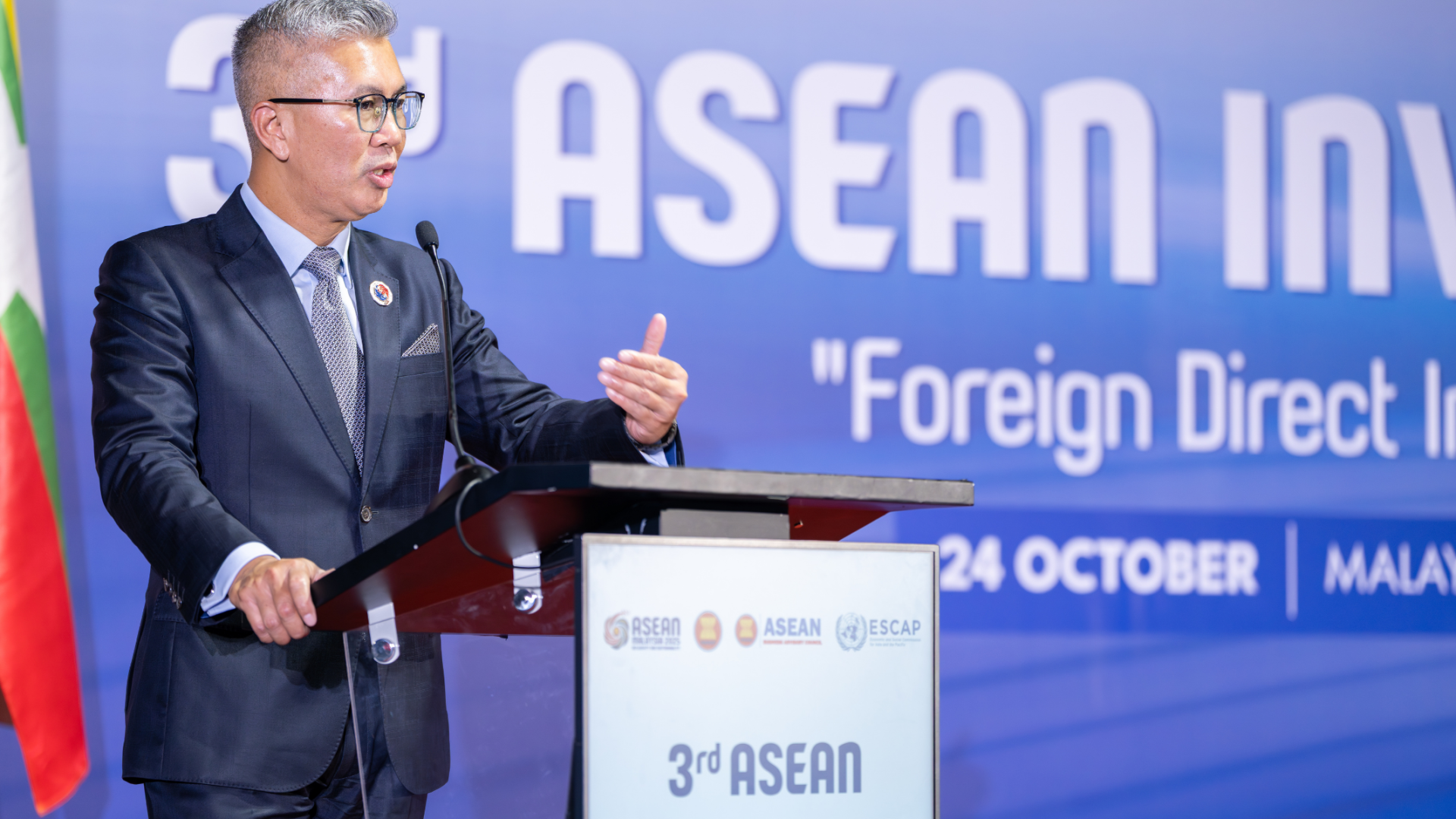
CLOSING KEYNOTE
YB SENATOR TENGKU DATUK SERI UTAMA
ZAFRUL TENGKU ABDUL AZIZ
MINISTER OF INVESTMENT, TRADE AND INDUSTRY
FOR
ASEAN INVESTMENT FORUM 2025
(AIF 2025)
24 October 2025 (Friday)
6:30 PM (Closing Session)
Hall 1, Malaysia International Trade and Exhibition Centre
(MITEC), Kuala Lumpur
SALUTATIONS
H.E. Tirta Nugraha Mursitama,
Deputy Minister for Investment Cooperation, Ministry of Investment and Downstream Industry, Indonesia
H.E. Ceferino Rodolfo,
Undersecretary of the Department of Trade and Industry and Managing Head of the Board of Investments, Philippines
H.E. Bountheung Douangsavanh,
Deputy Minister and Vice Chairman, Investment Promotion and Management Committee, Prime Minister’s Office, Lao PDR
H.E. Sar Senera,
Deputy Secretary General, Cambodian Investment Board/Council for Development of Cambodia
H.E. Armida Salsiah Alisjahbana,
Under Secretary General of the United Nations and Executive Secretary of ESCAP
H.E. Satvinder Singh,
Deputy Secretary General for the ASEAN Economic Community
YBhg Datuk Bahria Mohd Tamil Deputy
Secretary General (Investment & Management) Ministry of Investment, Trade and Industry, Malaysia
Excellencies, Distinguished Delegates, Ladies and Gentlemen,
1. As we close the third ASEAN Investment Forum, allow me to extend my gratitude to UN ESCAP, the ASEAN Secretariat, ASEAN-BAC, and most importantly our ASEAN Member States and private-sector partners for the constructive, solutions oriented dialogue we have had today.
2. Malaysia’s ASEAN Chairmanship is guided by a simple principle: to translate ambition into action, intention into impact, and decisions into deliverables. Our commitment is to move beyond aspirations to executing what investors, workers, and communities can see and measure.
3. Today has been precisely about that shift. I was informed that the morning session began with a candid discussion on what makes transition projects investment-ready: credible sponsors, transparent regulations, clear revenue models, and effective risk mitigation strategies.
4. These criteria set the tone for the subsequent sessions on industrial decarbonisation. Sectors discussed include biofuels and carbon capture; as well as smart digital manufacturing and advanced electronics. Others include health and life sciences manufacturing for regional resilience; as well as renewable energy ecosystems that integrate manufacturing, deployment, and 3 services. Together, all these form ASEAN’s executable investment story.
5. The crux of this potential is the ASEAN Regional Investment Promotion Action Plan, or RIPAP, endorsed by our Economic Ministers last year. RIPAP is ASEAN’s first region-wide framework for coordinating investment promotion, not through slogans but through practical tools that truly matter to investors, including:
• Regional and national value propositions built around value chains;
• Pipelines of investor-ready projects at different stages of maturity;
• Common KPIs and dashboards to track what we do, when we do it, and based on what key objectives; and
• Targeted outreach to industry multipliers who can unlock capital at scale.
6. This is also why the projects developed under RIPAP matter. They demonstrate that ASEAN can generate credible opportunities and present them country by country, and yet coherently based on key principles of one unified region.
7. That coherence is not merely cosmetic — it is our competitive edge in a world where supply chains are being reshaped by a tariff-tech-trade war, underscored by an evolving geopolitical order.
8. We also acknowledge the support of the United Kingdom’s Green Transition Fund in advancing RIPAP’s implementation through the ASEAN Green Investment Catalyst Project. This has played a key role in developing some of the investable projects featured here today.
9. Under Malaysia’s ASEAN Chairmanship theme of “Inclusivity and Sustainability”, our economic deliverables this year are focused not only on accelerating growth, but also on expanding opportunities, deepening regional resilience, and preparing ASEAN for the challenges and opportunities of the future economy.
10. All these priorities are embedded across our ASEAN work programmes, particularly the 2025 Priority Economic Deliverables (PEDs) under Malaysia’s Chairmanship.
11. We have PEDs on, among others, strengthening trade integration (ATIGA and ACFTA 3.0); promoting responsible investment (ASEAN Sustainable Investment Guidelines); 5 uplifting MSMEs (Centre of Excellence for MSMEs in Green Transition); and unlocking a USD2-trillion digital economy by 2030 (ASEAN Digital Economy Framework Agreement).
12. Together, these PEDs represent ASEAN’s economic priorities beyond 2025, priorities that are competitive, connected, inclusive and sustainable, further positioning the ASEAN region as a resilient and future-driven investment destination.
13. ASEAN’s economic priorities also present a valuable factor every investor seeks: policy predictability. This is clearly supported by ASEAN’s market size; institutionalised facilitation, transparency, and policy continuity. Through the AEC process and the forthcoming AEC Strategic Plan1, rest assured that we are aligning rules and modernising processes, so investors can deploy their capital with confidence.
14. Malaysia, in particular, has proactively refined various policies, strategies, and facilitation to attract more high-impact investments, via our New Investment Policy, guided by the National Investment Aspirations, the New Industrial Master Plan 2030, and the 13th Malaysia Plan.
15. We are also pushing forward important strategies like the National Semiconductor Strategy (NSS), Green Investment Strategy (GIS), and Circular Economy (CE) Policy Framework, to shape a sustainable and resilient future for Malaysia. A sustainable and forward-looking investment environment for Malaysia supports a more attractive investment landscape for ASEAN.
16. Indeed, in the first half of 2025, Malaysia’s approved investments rose 18.7% year-on-year to USD45 billion (RM190.3 billion), creating nearly 89,000 jobs, an encouraging signal of investor’s confidence in our shared direction.
Ladies and Gentlemen,
17. As we move forward with RIPAP implementation, three (3) imperatives will guide ASEAN’s collective efforts:
• Coherence – by aligning national promotion efforts with regional sector strategies to create a clear and connected investment landscape;
• Facilitation – by improving approval processes, aftercare services, and digital investor interfaces to make ASEAN not only attractive but also easier to invest in; as well as
• Inclusivity and sustainability – ensuring that every investment supports skills development, domestic linkages, MSMEs, women-led businesses, and industrial decarbonisation.
18. To put these principles into action, Malaysia will work closely with ASEAN partners to expand the pipeline of investable projects in key sectors such as biofuels, carbon capture and storage, smart manufacturing, renewable energy, and health manufacturing. We will also intensify our investor outreach in priority markets.
19. To our investor community: ASEAN stands as an open, integrated, and execution-focused region. The projects showcased today mark not the conclusion, but the co-creation of deeper collaborations and better capital mobilisation across ASEAN.
20. On that note, I thank you for your participation and partnership. Let us carry forward the momentum from today’s conversations and translate them into impact for a more prosperous, sustainable tomorrow for ASEAN.
Thank you.
Loading Viewer...
