
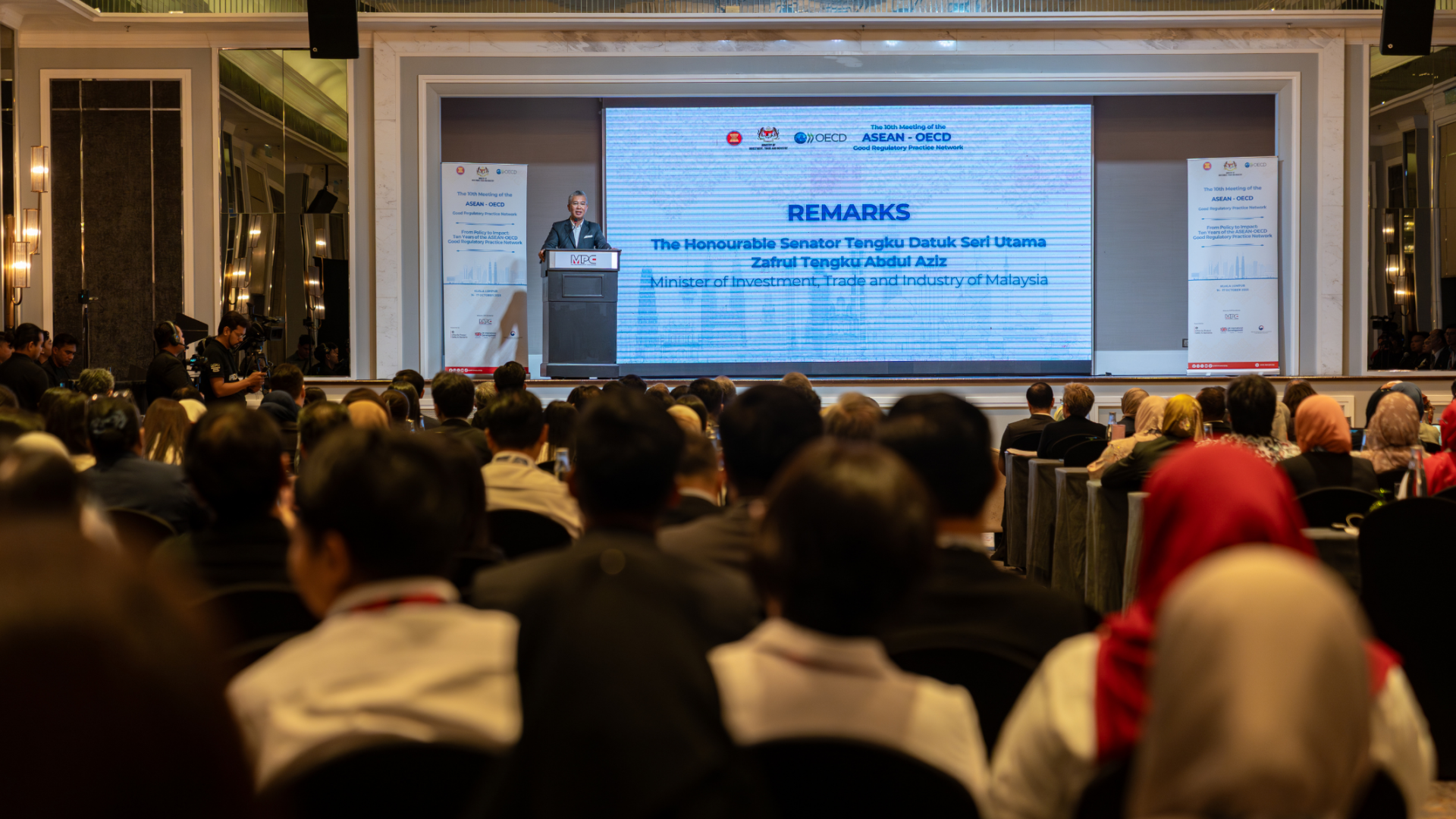
OPENING REMARKS
YB SENATOR TENGKU DATUK SERI UTAMA ZAFRUL
TENGKU ABDUL AZIZ
MINISTER OF INVESTMENT, TRADE AND INDUSTRY (MITI)
FOR
10TH MEETING OF THE ASEAN-OECD
GOOD REGULATORY PRACTICE NETWORK (GPRN)
From Policy to Impact: Ten Years of the ASEAN-OECD Good Regulatory Practice Network
15 OCTOBER 2025
JW MARRIOTT HOTEL, KUALA LUMPUR
YBhg. Dato' Hairil Yahri Yaacob
Secretary General Ministry of Investment, Trade and Industry (MITI)
YBhg. Datuk Kamaruzzaman Johari Chairman,
Malaysia Productivity Corporation (MPC) Mdm. Mastura Ahmad Mustafa Deputy Secretary General (Trade) / the ASEAN Co-Chair for GRPN
Mr. Mark Steel
Director of Regulatory Systems
Ministry of Business, Innovation and Employment, New Zealand / the OECD Co-Chair for GRPN
Eminent speakers and panellists, Distinguished guests,
Ladies and gentlemen,
Good afternoon and Salam Malaysia MADANI.
1. Thank you for having me at this milestone event, the 10th Meeting of the ASEAN-OECD Good Regulatory Practice Network (GRPN), marking the 10th Anniversary of ASEAN-OECD GRPN establishment.
2. To our esteemed delegates, a warm welcome to Kuala Lumpur, the birthplace of GRPN a decade ago. Your presence here affirms our shared conviction that Good Regulatory Practice, or GRP, is not only a technical exercise, but serves as a foundation of trust, competitiveness, and sustainable growth.
3. GRPN began as an idea – a belief that improved domestic regulations will lead to a more transparent policy environment. Today, we gather to celebrate that belief which has now taken strong root, and has built much better lives for our people through better regulations. Your principled stand has also grown this network from 40 participants at its inception, to over 200 policymakers today.
4. GRP is also aligned to the theme of Malaysia’s ASEAN Chairmanship, which is “Inclusivity and Sustainability.” In fact, GRP is a function of the concept of broad-based, sustainable growth - growth that truly cascades down to the general population, and where a nation’s prosperity is enjoyed by the masses.
WHY GRP MATTERS MORE THAN EVER
5. GRP also matters to businesses because, clear, transparent and consistent regulations by Governments empower them to plan effectively, foster investor confidence, and curate an economy that is also conducive for societal progress. Through the tool of Regulatory Impact Analysis, public consultations, and periodic reviews, every regulation serves a meaningful purpose, while driving overall productivity.
6. Let’s take ASEAN as an example. ASEAN today is not just a collection of individual economies. Its market has become increasingly integrated and proven itself to be a resilient manufacturing and services hub for global supply chains.
7. From 2014 to 2023, ASEAN's labour productivity grew at a compound annual rate of approximately 2.45%. This steady progress illustrates ASEAN’s competitiveness driven by efficiency and innovation. This efficiency and innovation could not have been achieved without improved governance. In fact, without GRP, even advantages such as competitive labour costs and abundant natural resources would not be properly capitalised on. It is the implementation of GRP that promotes the rule of law, maximises each country’s natural advantages, lowers the cost of doing business, and fosters trust within the region.
8. And thanks partly to GRP, the numbers speak for themselves: in 2024, ASEAN’s total merchandise trade amounted to an impressive US$3.844 trillion, while FDI inflows surpassed US$226 billion in 2024, representing an 8% increase, year-on-year. These metrics underscore robust investor confidence amidst global uncertainties.
MALAYSIA’S REFORM JOURNEY
Ladies and Gentlemen,
9. Malaysia’s industrial and economic reform journey has been underscored and enabled by GRP.
10. The NIMP2030, for example, has its own Delivery Management Unit (DMU) which tracks key metrics such as the manufacturing sector’s contribution to the country’s GDP, as well as the number of jobs and median wage in the manufacturing sector.
11. By translating GRP principles into practice, as of Q2 2025, we have achieved a RM3.5-billion increase in contribution to GDP; increased the number of workers in the manufacturing sector by 27,000 and increased median wage from RM1,976 (2021) to RM2,490.
12. Thanks to disciplined execution, our performance has helped Malaysia move up 11 places to 23rd in the 2025 World Competitiveness Ranking (WCR), our best ranking yet. This reflects improved economic performance, government efficiency, and improved investor sentiment.
13. Malaysia’s ongoing Bureaucratic Reform Programme has also contributed to our improved performance. Currently, there are over 1,000 regulatory improvement projects nationwide, collectively generating RM1.1 billion in compliance-cost savings as of September 2025.
14. Additionally, our new Government Service Efficiency Commitment Act 2025 or better known as ILTIZAM Act was gazetted earlier this year. It aims to improve quality, efficiency, and effectiveness of Malaysia’s public services, by reducing bureaucracy and red tape.
This landmark reform is the first in our region, utilised for the sole purpose of having a structured rule-making discipline through a legislation instrument.
15. The ILTIZAM Act institutionalises GRP through four key elements:
(i) 25% regulatory-burden reduction across ministries/agencies;
(ii) Mandatory three-year reviews of all regulatory instruments;
(iii) “One-in, One-out” rule for new regulations; and
(iv) Government regulatory ratings tied to incentives and transparency reports to Parliament.
16. These initiatives are not merely abstract targets, but practical tools designed to drive investment, enhance governance, and boost national productivity. We view them as a strategic measure to firmly position the country on a path toward achieving the 13th Malaysia Plan (RMK-13) goal to be ranked among the top 12 most competitive nation globally by 2033.
A DECADE OF THE ASEAN–OECD GRPN
Ladies and Gentlemen,
17. Over the last 10 years, GRPN has progressed from a mere dialogue forum, transformed into a results-oriented platform that adopts good regulatory practice across ASEAN. GRPN has helped institutionalise GRP in the overall ASEAN governance framework.
18. From linking SMEs to global value chains and easing business registration, to coordinating pandemic responses and advancing digital governance, the GRPN has clearly turned ambition into action.
19. The ASEAN–Canada FTA, for example, marks a significant milestone as the first multilateral agreement of ASEAN that includes a dedicated Chapter on GRP.
20. Together with the ASEAN GRP Core Principles in 2018, the ASEAN Handbook on GRP in 2022, and the 2016 – 2025 ASEAN GRP Work Plan, these instruments demonstrate that GRP is fast becoming part of ASEAN’s DNA.
21. GRPN has now become an anchor platform for ASEAN–OECD cooperation on regulatory reform. It is a recognition of OECD’s key Regional Policy Networks, raising ASEAN’s visibility in global regulatory dialogues.
LOOKING AHEAD: THREE PRIORITIES FOR THE NEXT DECADE
22. As we look forward into the next decade, Malaysia would like to propose three strategic priorities to drive our next phase of regulatory excellence:
(i) First, make GRP a driver of regional integration – utilising it to reduce non-tariff barriers, harmonise standards, and make ASEAN a truly seamless, attractive market for trade and investments;
(ii) Second, embed GRP in ASEAN’s future agenda – by integrating transparency, accountability, and evidence-based governance across all pillars of the ASEAN Community Vision 2045; and
(iii) Third, mainstreaming GRP in governance – turning GRP from policy principle into daily practice, ensuring that every rule made, reviewed, or repealed serves the people and sustains productivity.
23. Reflecting on ten years of partnership, we also need to look ahead. The journey of regulatory reform is never-ending, particularly given how quickly technology such as AI, quantum computing, robotics, IoT and the like are fast changing the trade and investment landscapes. This makes it tough for GRP to keep up. This is why ASEAN’s cooperation with the OECD has never been more valuable, and will remain valued for many years to come.
CONCLUSION: FROM COMPLIANCE TO CONFIDENCE
Ladies and Gentlemen,
24. As Malaysia reaffirms our strong collaboration with the OECD and our ASEAN partners under the 2022 MOU framework, let’s work towards keeping GRPN a living platform, not just for regulators, but also for businesses, academia, and civil society – this is the way forward to foster more ideas, invite more feedback, and empower more innovation.
25. Success is not about how many regulations we make, but by how many lives we improve through them. In line with today’s event theme, "From Policy to Impact”– that is our promise to the people of ASEAN. Thank you.
Loading Viewer...
