


The Southeast Asian Futures Initiative Centre (SEAFIC), in collaboration with All-Party Parliamentary Group Malaysia on Sustainable Development Goals (APPGM-SDG) and My SDG Centre for Social Inclusion, on 17 August 2026 convened a focus group discussion on economic security and mobility in the Klang Valley today. The closed-door session brought together fifteen (15) participants representing five (5) demographic groups central to Malaysia's urban economy: fresh graduates, heads of household, working single mothers, gig economy workers, and senior citizens, to examine the lived experience of urban households in B40 and M40 income brackets navigating the interconnected pressures of housing, employment, food security, transport, and daily cost volatility.
The event opened with welcoming remarks from Prof. Datuk Dr. Denison Jayasooria, Head of Secretariat for APPGM-SDG, setting the stage for the day's discussions. This was followed by a special address from Nurul Izzah Anwar, Executive Chairperson of Polity, who shared her perspectives on the themes at hand. The programme's keynote address was delivered by Tengku Datuk Seri Utama Zafrul Aziz, Chairman of SEAFIC, whose remarks anchored the session's broader discourse and set the tone for the sessions ahead.
Unpredictability, Not Housing Cost, Is the Real Squeeze
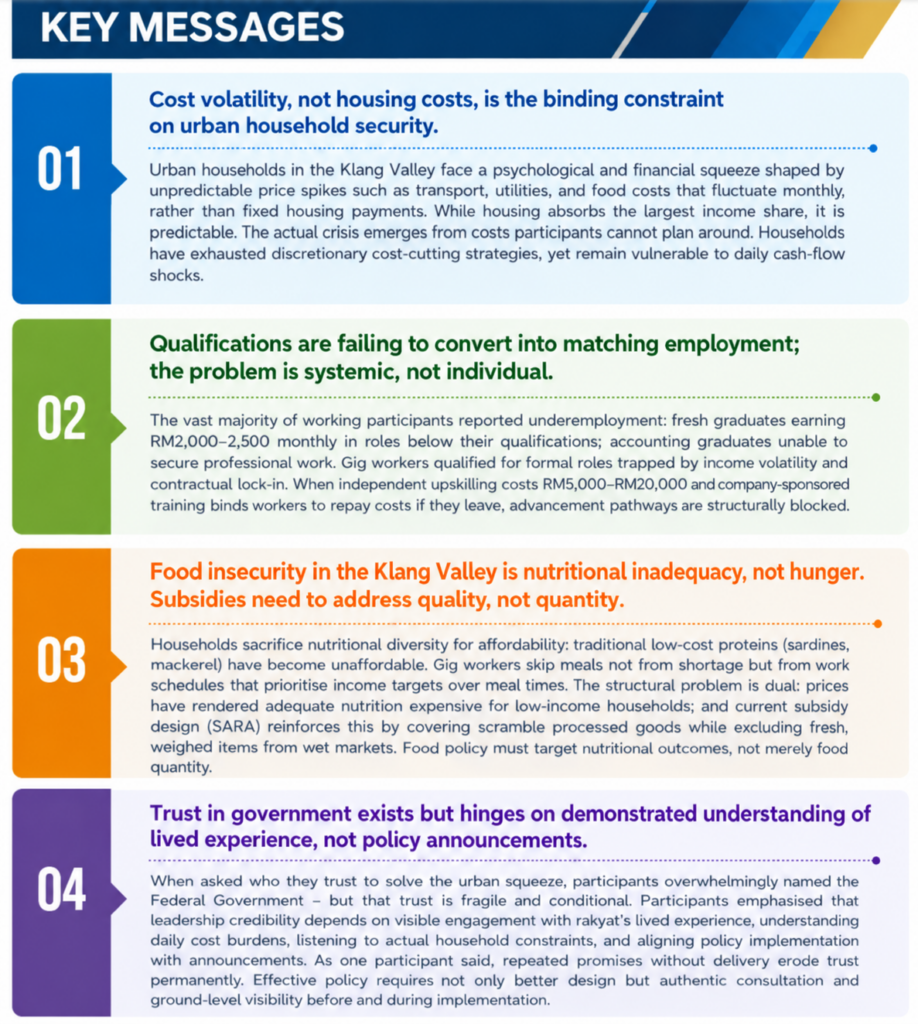
The discussion revealed that urban affordability is not a single crisis but a system of compounding pressures. Participants emphasised that unpredictable cost spikes, not fixed housing expenses, constitute the binding constraint on household planning and financial resilience. While housing absorbs the largest share of household income, its predictability renders it manageable; the acute psychological and financial squeeze emerges instead from daily fluctuations in transport, food, and utility costs that cannot be anticipated or planned around. Households reported exhausting discretionary cost-cutting strategies while remaining vulnerable to cash-flow shocks, suggesting that aggregate macroeconomic stability and nominal wage growth do not translate into economic security at the household level when structural barriers prevent these gains from reaching household budgets.
Food Insecurity Is About Nutrition, Not Hunger
Food insecurity in the Klang Valley manifests not as hunger but as nutritional inadequacy. Households sacrifice nutritional diversity for affordability as traditional low-cost proteins such as sardines and mackerel. However, these proteins have become unaffordable for their budgets, forcing substitution with rice, eggs, and vegetables alone. Government assistance schemes address food quantity through subsidies but are structured in ways that reinforce processed food consumption: the SARA subsidy system covers scannable packaged items while deliberately excluding fresh produce from wet markets that require individual weighing and transaction.
The M40 Are Squeezed but Structurally Invisible
Middle-income households in the M40 bracket face a distinct vulnerability. They earn slightly more than lower-income groups but encounter similar daily pressures and constraints, yet do not qualify for targeted assistance schemes designed for B40 households. They remain too poor to absorb rising costs without strain yet too affluent for policy recognition. Current policy classification does not account for life-stage costs such as children in school, aging parents requiring support, or unexpected health events that create vulnerability across multiple income brackets. As a result, M40 households experience acute economic pressure without any form of policy support.
Fixing Affordability Requires Systemic, Not Siloed, Reform
A central conclusion from the discussion was that urban affordability requires structural redesign of interconnected systems rather than isolated policy interventions. Housing policy must expand eligibility criteria, lower down payments, and align supply with employment centres rather than distant locations that multiply transport costs. Food assistance must incentivise nutritional adequacy by including fresh produce from wet markets in subsidy schemes and by decoupling food subsidies from other household costs so that nutrition is not sacrificed to pay for essential non-food items. Employment policy must create pathways out of gig work through affordable upskilling and portable credentials not locked to employers, and education systems must align curricula with labour market demand and coordinate with employers to ensure graduates can access roles they trained for.
The discussion underscored that raising the economic floor for Malaysia's urban vulnerable requires not only better-designed intervention mechanisms but a fundamental shift in how policy engages with, understands, and responds to household-level constraints.
*As a regional think-tank, SEAFIC recognises that these challenges are not unique to Malaysia alone. They point to a wider ASEAN reality, where urban populations across the region's capitals face similar pressures around affordability, employment, and economic security. Addressing these issues will require policy responses that are as interconnected as the challenges themselves.

ASEAN-GCC-China: A Brave New World?