


The Southeast Asian Futures Initiative Centre (SEAFIC) on 24 September 2026 convened SEAFIC's Roundtable #4, "Data Centres and the Compute Economy," bringing together government agencies, policy researchers and industry players for a closed-door discussion to discuss three questions: what tangible benefits data centres bring to host countries, how large the "compute economy" they generate really is, and what stands in the way of turning that potential into results.
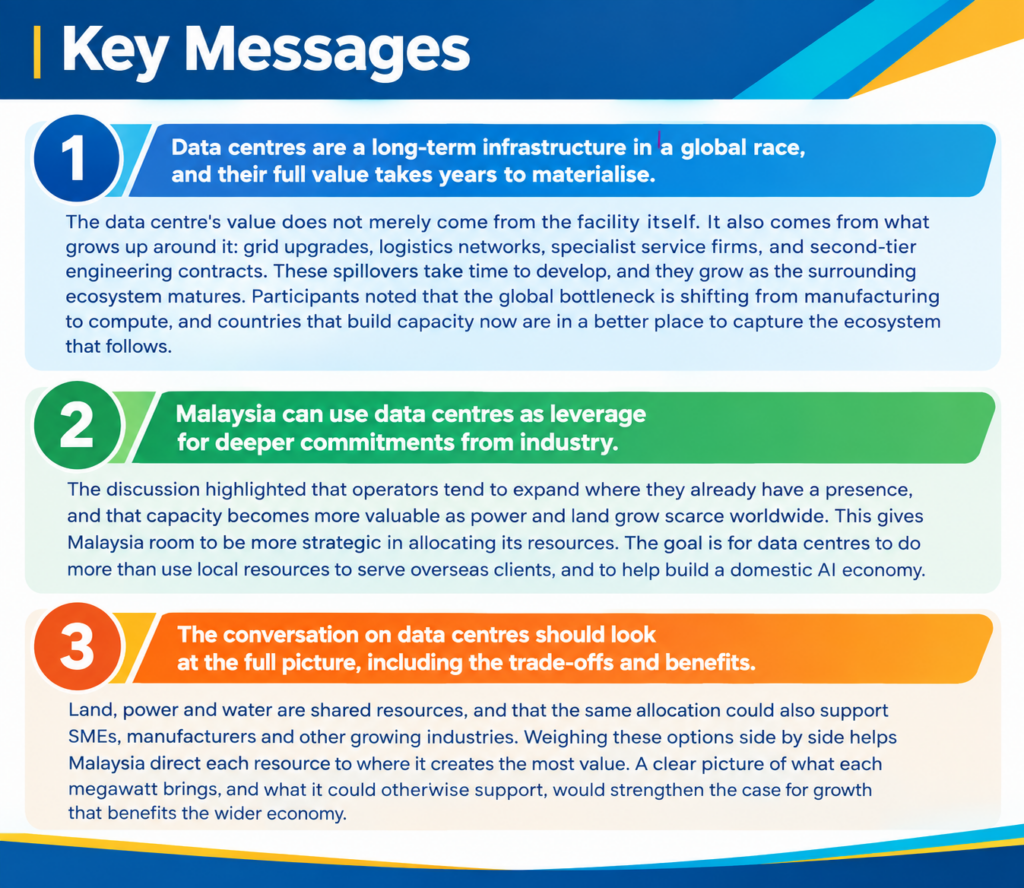
During the roundtable, participants examined the scale of recent investment and the jobs it has created, how local content should be defined, how the sector should be powered, and what are the trade-offs for Malaysia by directing land, power and water toward data centres.
Who Benefits from Malaysia's Data Centre Boom?
The session was opened with simple yet pertinent questions: who actually uses the compute being built in Malaysia, and who captures its value. On top of these questions, productivity in the sector has risen faster than wages. Looking at Malaysia’s neighbours such as Thailand, which recently imposed a moratorium affecting 49 sites over energy and public concerns, it gives a signal that governments in the region are tightening their approach on data centres
Rapid Growth, Well-Paid Jobs, But Few of Them
A government presentation then set out the sector's growth. Between 2021 and 2026, 220 data centre projects worth RM385.7 billion were approved, creating 8,396 jobs. Early-career salaries of RM3,000 to RM7,000 a month compared to the national median of around RM 2,900 (DOSM). A data centre task force set up in 2025 coordinates policy across ministries, and Malaysia now accepts only AI-focused, less water-intensive facilities. The presentation also outlined a proposed 30% local content requirement and the Data Centre Nexus platform, which helps local suppliers find partners. Nevertheless, participants noted that Malaysia's data centres employ about 2 people per MW, against about 7 in Singapore.
Power, Grid Access and the Price of Capacity
The discussion then turned to electricity. Data centre capacity in Malaysia grew from roughly 100 MW to more than 1,000 MW in about four years, a pace that the national grid unable to match. Transformers alone can take five years to deliver. Participants broadly agreed that isolated on-site power generation should be a last resort, and suggested a mechanism that allows qualified private generators to connect to the grid.
Participants also argued that capacity is a leverage. Other countries, for example, now grant new capacity to only those who would relocate AI labs into the country, and Malaysia can also be strategic to apply the same framework.
Data Centres Are Long-Term Infrastructure in a Global Race
The full economic returns from data centres will not show up in the first few years. In Ireland, data centres now account for 30% of electricity usage. It will take years for the surrounding ecosystem of suppliers, services, and skilled workers to take shape. Participants argued that Malaysia's vision should be set on these long-term gains.
This is also a global race. Capital and operators can move elsewhere — Singapore has already reversed its moratorium to stay competitive. Restrictions are easier to impose than to undo: a policy that takes a day to announce can take years to reverse. Countries that build the infrastructure will host the assets and capture the ecosystem, while those that hold back may still face the disruption even without the investment into this sector.
Better Measurement Needed Before the Next Decisions
The roundtable also noted that the evidence has not caught up with the investment. Malaysia needs a consistent method for measuring what data centres can deliver, including indirect spillovers such as second-tier engineering contracts, and clearer rules on what counts as local content. Participants called for proper assessment of the sector’s effects on SMEs, heat and water usage, and for state and local governments to be brought into the conversation.

Two Wrongs Do Not Make A Right