The Southeast Asian Futures Initiative Centre (SEAFIC), together with Universiti Brunei Darussalam (UBD), on 26 October 2026 convened SEAFIC's Roundtable #5, "Climate Research and Regional Environmental Governance in Southeast Asia," bringing together government officials, climate scientists, economists and diplomats for a closed-door discussion on three questions: how member states can agree on common standards for measuring and reporting fires, haze and emissions for better coordinated policymaking; how regional bodies such as the ASEAN Centre for Climate Change (ACCC) can advance their mandate, given the funding and support by various partners to shape policy across the region rather than exist in name only; and how research produced in the region can deliver meaningful change on the ground.
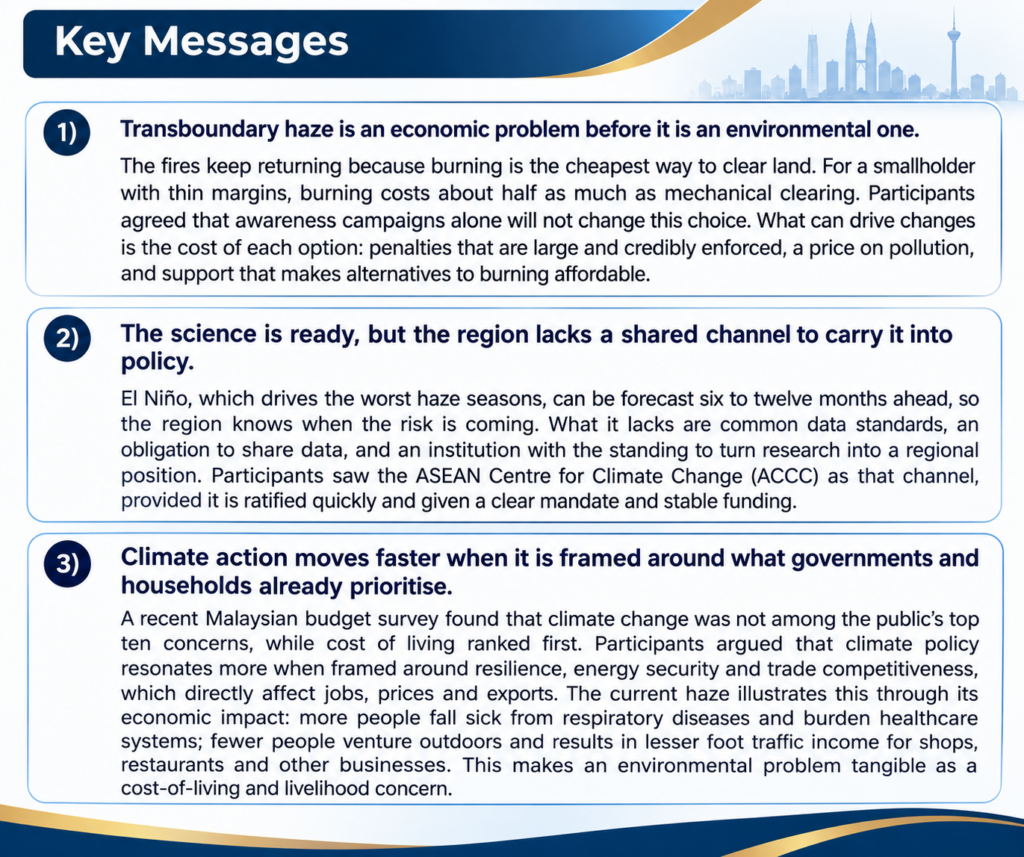
During the roundtable, participants examined why haze keeps recurring despite nearly three decades of regional agreements, what the science says about the years ahead, how incentives could be changed, and what the ACCC needs in order to become effective.
Why the Haze Keeps Returning
The session opened by placing this year's haze in context. More than 38,000 hotspots have been recorded in Kalimantan this season, compared with 19,681 in 2019 and 14,219 in 2023. The region has worked on this problem since the 1997 Regional Haze Action Plan and the 2002 ASEAN Agreement on Transboundary Haze Pollution, yet the fires continue.
Participants identified cost and underreporting as underlying reasons. On cost; burning a hectare of land costs around 3.5 million rupiah, against 7.7 million rupiah for mechanical clearing. As for underreporting. Independent estimates of fire extent have consistently been at least twice the official figures, and when countries and civil society clash over the scale of the problem, mounting a coordinated whole-of-society and whole-of-government response becomes challenging. Participants also noted that the haze agreement has no mechanism for third-party dispute settlement, which leaves affected countries with little recourse.
The Science Is Ahead of the Policy
A climatologist set out the physical picture during the roundtable. Temperatures over Borneo have risen by about one degree since 1979, and under a high-emissions scenario they could rise by four to five degrees by the end of the century. Haze peaks when El Niño brings drought to southern Sumatra and Kalimantan between July and October. Because El Niño can be predicted six to twelve months in advance, the challenge is not forecasting the drought but preventing it from turning into fire.
This challenge will grow. Extreme El Niño events are projected to become about twice as frequent, and warming alone is expected to bring dry seasons even in years without El Niño. Participants noted that research on these risks already exists, but much of it stays in academic journals. Of the 100 most cited papers on climate change and haze in the region, about 90% were written by authors from outside ASEAN. Vietnam was cited as a model: its law requires national climate projections to be updated every five years and used in planning.
Changing the Incentives to Burn
An economist described haze as a classic tragedy of the commons. Each landholder gains from cheap burning, while the costs fall on everyone else. The 2015 haze alone was estimated to have cost around S$20 billion, and recent studies link long-term exposure to PM2.5 with effects on mental health and cognition.
Because monitoring vast areas of land is expensive, participants argued that penalties must be large and enforced consistently, without room for negotiation. Market-based tools such as a pollution tax could complement them, alongside subsidies and technical help for alternatives to burning. Participants also discussed adapting the "Climate Club" model proposed by economist William Nordhaus. Under this approach, member countries would set staggered targets to reduce burning, and countries that do not take part would face trade penalties. Over the longer term, a regional carbon market drawing on the EU Emissions Trading System was raised as a possibility.
Giving the ASEAN Centre for Climate Change Its Bite
Brunei, which hosts the ACCC at UBD, outlined the centre's progress. All ten member states signed the establishment agreement in 2025, but six ratifications are needed before it can operate, and so far three countries have moved to ratify. Until then, the centre cannot hire staff or run projects, even though funding from Brunei and dialogue partners such as New Zealand is already in place.
Participants identified what the centre will need to be effective: a clear regional mandate distinct from the host country, sustainable funding that does not rely on Brunei alone, and open, comparable data. Open data matters because it allows researchers and think tanks to test official figures; without it, governments hold most of the information. The ACCC could also give ASEAN a common evidence base at climate negotiations, where member states often arrive with different positions. A diplomat urged that ratification be pursued actively at every level so that the agenda is not forgotten.
Making the Case Beyond the Environment
The final discussion turned to how climate action can win political support. Participants pointed to trade measures such as the EU Carbon Border Adjustment Mechanism (CBAM), with similar schemes under consideration in the UK, Australia and Japan. One study estimated that CBAM shifts about US$9 billion from developing to developed economies while cutting global emissions by only 0.1%. Research on what these measures mean specifically for Southeast Asia remains limited.
The closing remarks returned to public awareness. Those in the room understood the stakes, but most on the ground do not yet see climate change as a priority. The haze offers an opening, as it inflicts tangible damage towards businesses and health. Participants called for a whole-of-ASEAN approach linking government, industry and the public, and additionally noted the growing power demand of AI and data centres should be part of that conversation.

Can Malaysia Survive In The New Global “disorder”?