
PUBLICATION PREVIEW

Rare Earths: Barriers and opportunities for ASEAN
Summary: Rare earth elements present a strategic opportunity for ASEAN amid global supply-chain diversification. China's dominance in refining and magnet manufacturing, alongside growing demand from electric vehicles, renewable energy and advanced industries, is prompting countries to diversify supply. ASEAN can benefit from this shift by leveraging its mineral resources, existing processing capabilities and emerging downstream investments. Regional capabilities remain fragmented across mining, separation, metallisation, alloying and magnet manufacturing. Developing an integrated supply chain will require commercially viable investments, reliable feedstock, technological expertise and long-term purchasing commitments. Regional cooperation could help connect these activities while reducing duplication and competition among member states. Sustainable development and effective governance will determine ASEAN's long-term competitiveness. Rare earth extraction and processing carry environmental, social and commercial risks, particularly where regulatory oversight is weak. Stronger safeguards, transparent supply-chain traceability and meaningful community participation are essential. ASEAN's Minerals Development Vision 2045 provides a framework for aligning national ambitions with responsible regional industrial development.
The full report will be released next week. Stay tuned for further insights on the SEAFIC's website.
THE PAST WEEK
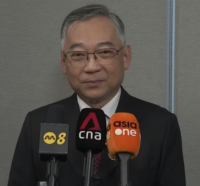
ASEAN signs landmark Digital Economy Framework Agreement (DEFA)
ASEAN’s first standalone landmark agreement aims to accelerate regional digital integration. Read more.
Summary: ASEAN member states signed the bloc’s first standalone, legally binding Digital Economy Framework Agreement (DEFA) on 14 November 2026 in Manila, alongside the 28th ASEAN Economic Community Council Meeting during the 49th ASEAN Summit. Attended by ASEAN Secretary-General Dr Kao Kim Hourn, the signing marks a milestone in efforts to build an open, secure, interoperable, competitive and inclusive regional digital economy. The agreement covers cross-border data flows, end-to-end digital trade, source-code protection, cybersecurity and artificial intelligence. It aims to improve interoperability across technology, e-commerce, payments, logistics and supply chains, enabling businesses to expand across the region. Singapore Deputy Prime Minister Gan Kim Yong said DEFA balances ambition with member states’ different levels of readiness. It allows flexibility for national concerns, including privacy, commercial confidentiality and security, while establishing common rules for data transfers. The framework could also facilitate electronic trade documentation, reducing processing time and costs, and support closer cooperation on digital payments and identification. DEFA is expected to enter into force in early 2027.

ASEAN and Canada substantially conclude negotiations on a landmark free trade agreement
ASEAN’s economic agenda gets a big push, opening new opportunities for regional trade and investment. Read more.
Summary: Canada and ASEAN have substantially concluded negotiations on a free trade agreement (ACAFTA), marking a step towards strengthening economic ties between the two regions. Announced by Canadian Prime Minister Mark Carney in Manila on 14 November 2026, the agreement is expected to improve market access, reduce or eliminate tariffs on Canadian exports and support closer integration with Asian supply chains. ASEAN’s 11 member states represent almost 700 million people and a combined economy approaching USD 6 trillion making the bloc an important partner as Canada seeks to diversify its trade relationships and reduce reliance on a single trading partner. The agreement would also broaden ASEAN’s economic partnerships beyond the region, as it would be the bloc’s first free trade agreement with a North American partner. Canada has pledged CAD 5 million in assistance to help ASEAN members prepare for ratification. Negotiations began in 2021, with both sides aiming to sign the agreement in 2027. Two-way merchandise trade between Canada and ASEAN reached CAD 52.5 billion in 2025.

Four ASEAN central banks deepen cooperation on local currency transactions
Malaysia, Indonesia, Thailand and the Philippines are moving to settle regional trade and investment in their own currencies. Read more.
Summary: The central banks of Malaysia, Indonesia, Thailand and the Philippines signed a memorandum of understanding (MoU) on 13 November 2026 to expand cooperation under the Local Currency Transaction (LCT) Framework. The agreement aims to promote the use of local currencies in settling cross-border transactions, including trade and investment, reducing the need for multiple currency conversions. This could lower transaction costs, improve settlement efficiency and give businesses greater flexibility in managing foreign exchange risks. The agreement expands an existing arrangement between Malaysia, Indonesia and Thailand, which first established bilateral cooperation on local currency transactions in August 2023. By bringing the Philippines into the framework, the four central banks aim to broaden the use of local currencies across their markets and strengthen regional financial cooperation. The initiative forms part of wider efforts to deepen ASEAN's financial integration, while giving businesses additional options for conducting cross-border transactions amid global currency volatility.
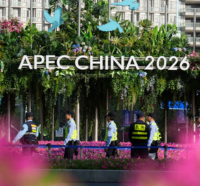
APEC CEO Summit 2026 convenes business leaders to strengthen Asia-Pacific economic cooperation
More than 2,000 business and political representatives gather in Shenzhen to explore opportunities in trade, technology and regional connectivity. Read more.
Summary: The Asia-Pacific Economic Cooperation (APEC) Summit 2026 held on 17-18 November 2026 in Shenzhen, China, under the theme “To Prosper and Win the Future Together”, attracted more than 2,000 representatives from 21 APEC economies and 13 non-APEC economies. Organised by the China Council for the Promotion of International Trade (CCPIT), the summit featured participants from 115 Fortune Global 500 companies, including major firms from the United States and China.
As part of the 2026 APEC Economic Leaders' Week, the summit also marks a milestone in its 30-year history with the launch of the Shenzhen Initiative, its first outcome document issued in the form of an initiative. The document sets out business-sector recommendations for strengthening regional economic cooperation. In his welcome address, CCPIT chairman Ren Hongbin called for the dialogue to generate fresh ideas and consensus to support regional cooperation and global growth. Discussions centred on advancing the proposed Free Trade Area of the Asia-Pacific (FTAAP), strengthening regional connectivity, expanding digital economy cooperation, developing AI innovation ecosystems and accelerating the green transition.

Anwar calls for green lanes to safeguard regional food supplies during crises
ASEAN must strengthen its collective self-reliance to safeguard access to essential goods amid growing global uncertainties. Read more.
Summary: At the plenary session of the 49th ASEAN Summit in Manila on 15 November 2026, Malaysian Prime Minister Anwar Ibrahim called on member states to establish trusted “green lanes” to keep essential food supplies and agricultural inputs moving across borders during crises. Anwar stressed that recent global shocks had exposed the risk of heavy reliance on external suppliers, making it imperative for ASEAN to strengthen their intra-regional trade to secure access to essential agricultural inputs, including fertilisers, seeds and animal feed. He also called for better coordination of regional food reserves, including the ASEAN Plus Three Emergency Rice Reserve, to improve the region's preparedness for supply disruptions. Warning against complacency, Anwar highlighted how climate change and environmental degradation increase the likelihood of future pandemics, posing further risks to regional food security. Beyond food supplies, he urged greater cooperation on medicine security through pooled procurement, stockpiling and expanded regional production of essential medicines and vaccines. These proposals underscore the need for ASEAN to strengthen collective self-reliance and build more resilient regional supply chains amid growing global uncertainties.

Singapore launches USD 500 million initiative to strengthen Southeast Asia’s food resilience
New programme aims to mobilise public and private investment in climate adaptation projects and support regional food security. Read more.
Summary: Singapore launched the Scaling Projects and Investments for Resilience in Asia (SPIRE Asia) Programme at COP31 on 10 November 2026, aiming to mobilise investment in climate adaptation across Southeast Asia's agri-food sector. The initiative includes a proposed blended finance fund targeting up to USD 500 million to support projects that struggle to attract conventional financing.
Developed by Singapore's National Climate Change Secretariat, Monetary Authority of Singapore and Enterprise Singapore, alongside Temasek Trust, the programme has three pillars: a data platform to identify climate risks and investment opportunities, a market development facility to prepare projects for investors, and the financing fund. By combining project development support with catalytic capital to reduce investment risks, SPIRE Asia seeks to attract greater private-sector participation in agricultural adaptation.
The initiative could help scale climate-resilient farming practices, particularly among smaller agricultural businesses, while creating investment opportunities for Singapore-based financial institutions and agri-tech providers. Its success will depend on translating the proposed financing into investments and measurable resilience outcomes across the region.
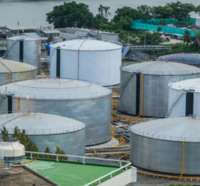
Indonesia, Thailand, Philippines explore joint emergency fuel stockpiling arrangement
ASEAN gains its first shared fuel reserve, giving the bloc a standing instrument for managing oil supply shocks from outside the region. Read more.
Summary: A proposed regional mechanism would allow participating countries to access fuel stored in neighbouring states during supply emergencies, without having to maintain all their reserves domestically. Announced during the ASEAN Business and Investment Summit in Manila on 14 November 2026, the initiative involves preliminary agreements between the Philippine National Oil Company Exploration Corporation (PNOC-EC) and storage operators in Indonesia and Thailand. It will explore an oil-ticketing mechanism, allowing participating countries to pay in advance for the right to access specified quantities of fuel held in another country's storage facilities during emergencies. This could provide the Philippines with access to diesel and petrol supplies without requiring it to establish additional storage facilities or purchase large fuel reserves upfront. The initiative is supported by the Economic Research Institute for ASEAN and East Asia (ERIA), with a wider regional arrangement potentially launching as early as 2027. Laos and Timor-Leste have also expressed interest in participating. The proposal reflects growing efforts to strengthen ASEAN's collective preparedness against external energy supply disruptions and improve regional energy security.
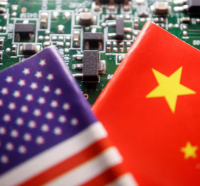
US chip restrictions threaten to reignite trade tensions with China
Tighter controls on access to advanced semiconductors could draw Southeast Asian data-centre operators into the US-China technology rivalry. Read more.
Summary: The Nvidia saga has prompted the White House to tighten advanced chip access at overseas data centres, over revelations of former company boss, Jensen Huang. The issue has intensified US scrutiny of semiconductor exports to China. Against this backdrop, Washington has introduced new licensing requirements for advanced chip shipments to data centres in Southeast Asia, including Malaysia, Singapore, Thailand and Indonesia, particularly those supplying computing power to Chinese technology firms. Further proposed measures could require manufacturers to track high-end chips and restrict exports of advanced chipmaking equipment to China. Beijing has condemned the restrictions and warned of countermeasures, potentially drawing on its expanding export controls covering rare earths, critical minerals, artificial intelligence and biotechnology. The escalation threatens to undermine the October 2025 US-China trade truce and trigger another cycle of retaliatory trade measures, with implications for regional technology investment and supply chains.
STRATEGIC INSIGHTS
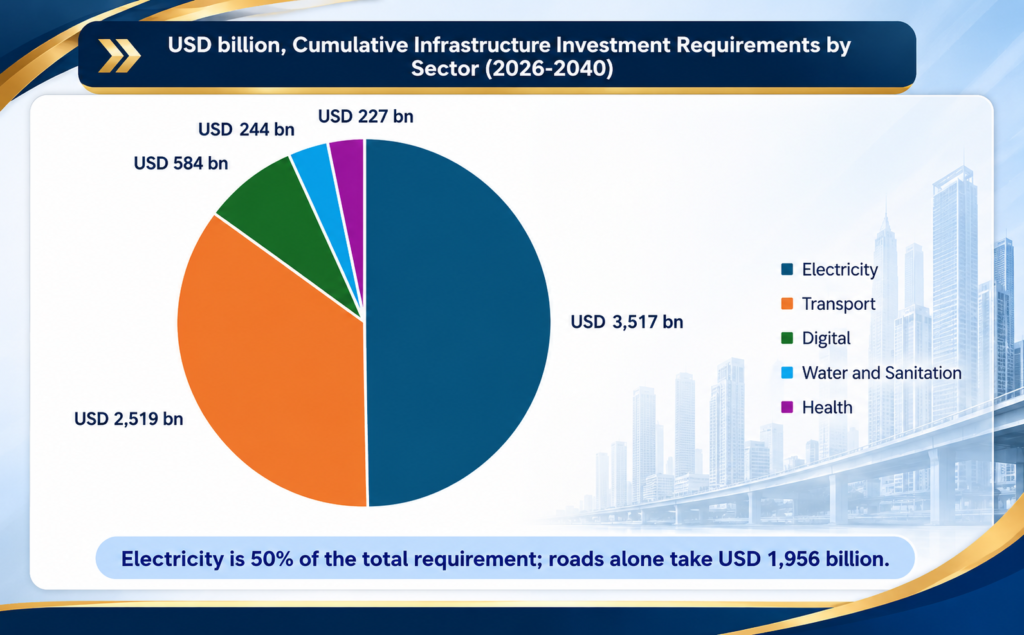
Power accounts for half of ASEAN’s infrastructure needs as the region faces a USD264 billion annual financing gap
The Asian Development Bank (ADB) estimates that ASEAN will need USD7.1 trillion in infrastructure investment over 2026–2040, measured in constant 2015 prices. Electricity is the largest component, accounting for USD3,571 billion, or half of the total. Transport requires a further USD2,519 billion (35.3%), while digital infrastructure, water and sanitation, and health account for the balance. Within the USD584 billion digital requirement, mobile broadband accounts for USD311 billion and data centres for USD150 billion.
If public investment continues at its recent share of GDP, ADB estimates that it will cover about 45% of ASEAN’s infrastructure needs. That leaves a financing gap of USD264 billion a year, equivalent to just over 4.8% of regional GDP and nearly USD4 trillion over 15 years. ASEAN’s total investment requirement averages 8.7% of GDP annually, compared with 7.3% for Asia and the Pacific. Electricity infrastructure alone requires investment equivalent to 4.4% of ASEAN’s GDP each year.
Malaysia illustrates the challenge of planning grid investment as demand grows. Tenaga Nasional Berhad (TNB) reported that actual data centre load more than doubled to 1,256 MW in June 2026, from 603 MW a year earlier. Its secured pipeline comprised 61 projects with a combined maximum demand of 8.35 GW, including 5.6 GW in Johor. June’s actual load was equivalent to about 22% of the 5.65 GW in maximum demand associated with projects already on TNB’s system. Peninsular Malaysia’s overall system demand reached a record 22,014 MW on 6 August 2026. For utilities and regulators, the planning challenge is to time grid upgrades as demand ramps up and establish how the costs will be recovered.
Electricity absorbs half of ASEAN's USD7.1 trillion infrastructure requirement to 2040; data centres take USD150 billion
THE WEEK AHEAD: STRATEGIC WATCHLIST
29th Brunei Darussalam - Indonesia - Malaysia - Philippines East ASEAN Growth Area (BIMP-EAGA) Ministerial Meeting and 34th Senior Officials Meeting (23 - 25 November 2026)
Why it matters: The meetings will be held in Brunei Darussalam, bringing together ministers, senior government officials from Brunei, Indonesia, Malaysia and the Philippines, alongside relevant regional stakeholders. The meetings will provide a platform to review progress in subregional cooperation and discuss priorities under BIMP-EAGA Vision 2035, adopted in May 2026. Key areas of focus include strengthening cross-border connectivity, trade and investment, energy resilience, food security and digital integration. Discussions will also take place against the backdrop of the Three-Year Rolling Pipeline of Projects (RPOPs 2026–2028), which identifies priority infrastructure, trade facilitation and transport connectivity projects across the subregion. It will be particularly important in setting implementation priorities for the new ten-year roadmap and advancing collaborative projects across the subregion.
Source: BIMP-EAGA
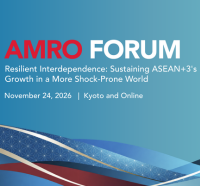
AMRO Forum 2026 (24 November 2026)
Why it matters: The ASEAN+3 Macroeconomic Research Office (AMRO), Japan's Ministry of Finance and the Asian Development Bank Institute will co-organise the fifth AMRO Forum on 24 November in Kyoto, Japan. Bringing together regional policymakers, central bankers, economists, academics and financial-market participants, the forum will examine how ASEAN+3 economies can sustain growth amid increasing global uncertainty. Discussions will focus on maintaining macroeconomic stability, managing external economic shocks and strengthening regional integration while preserving trade, investment and supply-chain connectivity. The forum will also consider longer-term structural challenges affecting regional resilience and economic growth.
Source: AMRO Forum 2026

2026 Thailand Cloud and Datacentre Convention (26 November 2026)
Why it matters: Organised by W.Media, the convention will be held in Bangkok, Thailand, bringing together over 1,500 participants, including policymakers, cloud service providers, data-centre operators, investors, technology companies and enterprise representatives. With more than 70 speakers expected, discussions will examine Thailand's growing role in Southeast Asia's digital infrastructure sector. Key topics include addressing electricity-grid constraints, improving energy storage and power distribution, developing renewable energy procurement through direct power purchase agreements (PPAs), and building sustainable, AI-ready data centres. The discussions will also highlight the challenge of ensuring that electricity infrastructure keeps pace with rising investment in AI and digital services, an increasingly important consideration for ASEAN's energy security and digital competitiveness.
